

What Is Wedding Vendor Financing?
Wedding vendor financing is short-term working capital that covers upfront costs (inventory, equipment, staffing) before couples pay their final invoices. Because wedding revenue clusters in peak months (June through September), most vendor businesses face a predictable cash flow gap between what they spend and when they get paid. Revenue-based financing solves that gap by providing capital upfront, with repayments that automatically adjust to your actual sales volume each day.
June through September represent peak wedding season. The Knot’s 2026 study tracking 10,000+ couples shows June hits 12% of annual weddings, August reaches 10%, and September peaks at 15%. Add May (10%) and October (17%), and summer through fall dominates the calendar.
For wedding vendors, that concentration creates both opportunity and a real cash flow challenge. Approximately 2 million weddings happen annually in the U.S., generating a $66 to $100 billion market. Wedding vendors sign an average of 20 contracts in 2026, but those bookings cluster heavily in peak months.
The pressure hits hardest in May. You’re finalizing June preparations while managing July and August contracts simultaneously. Caterers need food inventory and staffing before events. Florists require substantial flower purchases timed to arrival dates. Photographers invest in equipment and backup gear. Venues complete facility improvements before hosting season begins.
Traditional bank financing doesn’t work for event-based businesses. Banks see irregular monthly revenue and classify wedding vendors as high risk, despite profitable track records. Approval takes 60 to 90 days, missing your ordering windows for flowers, food, and supplies entirely.
Revenue-based financing solves this timing problem. You receive capital for inventory, equipment, and operations. Repayment aligns with your booking-driven revenue pattern. When June and July weddings generate concentrated income, repayment accelerates. During slower winter months, repayment decreases proportionally.
Understanding Wedding Vendor Revenue Patterns
Wedding vendor businesses run on event-driven cash flow. Revenue concentrates in specific months and depends on booking timelines that create extended gaps between costs and income.
Seasonal Booking Concentration
Peak season patterns are consistent year over year. September leads with 15% of annual weddings, followed by October (17%), June (12%), May (10%), and August (10%). That means 47% of weddings compress into four peak months (June through September), with adjacent months adding additional volume.
For vendors, this translates to 50 to 60% of annual revenue occurring in a five-month window. The other seven months generate significantly lower income while fixed costs like rent, utilities, insurance, and year-round staffing continue without interruption.
Regional variations matter too. Southern states see more distributed wedding seasons thanks to moderate climates. Northern states compress weddings into tighter spring-through-fall windows. Vendors in colder climates face more extreme seasonal revenue swings as a result.
Booking Lead Times Create Cash Flow Gaps
Vendors book peak season weddings months in advance. Florists get booked an average of 5.7 months before event dates. Venues often book 8 to 12 months ahead for popular dates. Photography and catering typically book 6 to 9 months in advance.
That lead time creates a painful cash flow gap. You’re securing June bookings in December or January when cash reserves sit at their annual low, right after slow fall and winter months, right? Deposits help but rarely cover your actual upfront costs.
Couples fund 88% of weddings personally, which makes them price-sensitive. When 44% of couples adjust plans to cut costs and 84% expect rising expenses, vendors face real pressure to offer payment flexibility while managing their own capital needs at the same time.
Multiple Vendor Coordination
Average weddings involve 13 to 14 vendors (The Knot data). For venues and caterers serving as primary coordinators, that means managing relationships with florists, photographers, DJs, rental companies, and specialty vendors. You’re often the payment intermediary, collecting from couples and paying sub-vendors, which creates temporary cash outflows before your own income arrives.
Vendor-Specific Capital Requirements
Different wedding vendor types face distinct capital needs based on their business models and service offerings.
Wedding Catering Capital Needs
Catering is the most capital-intensive wedding vendor category. Full commercial catering operations require $585,000 to $1.1 million in startup capital, including kitchen equipment ($140,000), leasehold improvements ($250,000), and initial inventory ($10,000 to $50,000).
Event-specific operating costs run $7,000 to $16,000 per 100-guest wedding, with per-person costs ranging from $70 to $135, including food, beverages, staff, tax, and gratuity. Larger weddings with 120 to 250 guests can require $10,000 to $35,000 in upfront costs before final payment arrives.
You’re purchasing perishable inventory days before events, paying staff wages regardless of when couples pay final invoices, and maintaining commercial kitchen facilities year-round. That capital intensity makes catering businesses particularly sensitive to cash flow timing. Working capital solutions can cover exactly these gaps without requiring you to tap personal savings between bookings.
Wedding Florist Working Capital
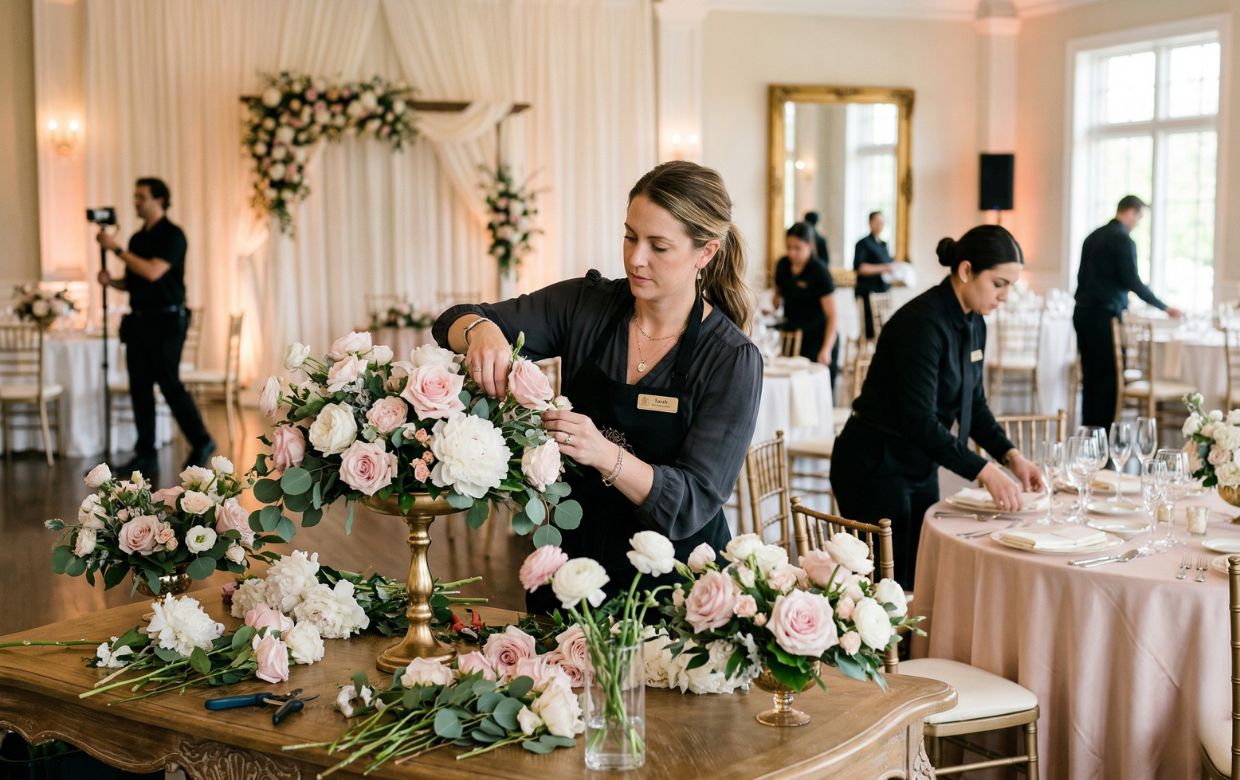
Florists handle an average of 668 stems and create 21 to 22 arrangements per wedding. Fresh flowers require ordering 5 to 10 days before events with full payment to wholesalers upfront. A single wedding can require $2,000 to $10,000 in flower costs, paid before couples deliver final payment.
Commercial cooler investments run $5,000 to $15,000 for walk-in units necessary to store fresh inventory. Design supplies, containers, and floral foam represent ongoing costs. Peak season requires maintaining substantial cooler capacity across multiple concurrent weekends.
Perishable flowers ordered for a Saturday wedding have zero salvage value if unused. Unlike equipment that retains some resale value, an over-ordered stem count is a complete loss. Accurate ordering is critical, and that accuracy depends on having the cash flow to order confidently rather than conservatively.
Photography and Videography Equipment
Professional wedding photography requires $5,000 to $20,000 in camera equipment, lenses, and lighting gear. Backup equipment is non-negotiable since equipment failure during a once-in-a-lifetime event is simply not an option. Editing software subscriptions add approximately $600 annually.
Photographers face booking deposit challenges too. Couples typically pay 25 to 50% deposits at booking with final payment due before or on the wedding day. That means carrying receivables for months while maintaining and upgrading equipment that depreciates with every shoot. Equipment financing gives photographers a way to stay current with gear without draining the cash reserves needed for day-to-day operations.
Venue Operations Capital
Wedding venues require facility improvements, furniture, decor, and ongoing maintenance. Commercial venue operations likely require $250,000 or more in leasehold improvements, plus tens of thousands in tables, chairs, linens, and decorative elements.
Venues typically collect deposits at booking but face extended payment timelines regardless. You’re maintaining facilities year-round, paying property costs every month, while revenue concentrates in peak season. Venue improvements and upgrades often happen during the off-season precisely when cash reserves are at their lowest. Platform Funding’s hotel and hospitality industry funding programs are built specifically for this cycle.
Equipment Financing for Photography and Catering Operations
Wedding vendors often overlook equipment financing as a capital tool separate from working capital. Photographers can finance camera bodies, lenses, and lighting systems on terms that preserve working capital for booking-specific expenses. Caterers can lease commercial kitchen equipment, refrigeration units, and transport vehicles, spreading major equipment investments over time while using revenue-based financing for event-specific food and staffing costs.
The combination gives you both long-term equipment financing for assets that serve multiple seasons and flexible working capital that adjusts to your event-driven cash flow. Many successful wedding businesses use this dual approach to maximize financial flexibility during peak season.

Deposit Structures and Payment Timing Challenges
Industry-standard payment structures create predictable cash flow challenges that financing directly addresses.
Typical Deposit and Payment Schedules
Most wedding vendors follow a similar structure: 25 to 50% deposits at signing, 25 to 50% progress payments 30 to 60 days before the event, and final payment due 7 to 30 days before or on the wedding day. Some vendors require full payment 30 days ahead for perishables.
That structure protects you from cancellations but creates brutal cash flow gaps. A June 2026 wedding booked in December 2025 brings a $5,000 deposit but holds the remaining $15,000 until May or June 2026. Planning, coordinating, and preparing start months earlier. Your expenses don’t wait for the final invoice. Bridge financing exists precisely for this kind of gap.
Managing Multiple Event Cash Flows
With vendors averaging 20+ contracts in 2026, you’re juggling multiple payment timelines simultaneously. June weddings generate final payments in May and June. July weddings pay in June and July. August events pay in July and August. The inflows overlap but come in unevenly.
Expenses don’t follow the same rhythm. Ordering flowers for three different June weekends happens simultaneously in early June. Catering prep for multiple events compresses into tight timeframes. Equipment needs pile up as concurrent bookings approach. Your expense spike comes before revenue arrives.
Understanding the gap between operating expenses and incoming payments is exactly what working capital management is designed to address. Vendors who plan their capital needs ahead of season consistently outperform those reacting to shortfalls.
Subcontractor and Supplier Payment Terms
Many vendors work with subcontractors or specialty suppliers who operate on different schedules than couples pay. Rental companies want payment 7 days before delivery. Specialty linens require 50% down and the balance on delivery. Wholesale florists require payment at pickup.
You’re paying suppliers before couples pay you, temporarily funding the difference out of working capital. Multiply that across 20+ events, and the capital requirement grows fast.
Revenue-Based Financing for Event-Based Businesses
Revenue-based financing is particularly well-suited to businesses with event-driven, seasonal revenue patterns like wedding vendors.
How It Works for Wedding Vendors
You receive capital ranging from $5,000 to $500,000 depending on your revenue history and business size. Instead of fixed monthly payments, you repay a percentage of daily credit card sales, typically 5 to 20%.
During peak June through September months when final wedding payments process, repayment accelerates naturally. During slower October through March months when booking activity drops, repayment slows in proportion to your actual revenue. You’re never forced into payments larger than your business can support.
For wedding vendors processing $30,000 to $60,000 in monthly payments during peak season, repayment happens quickly. During off-season months with $5,000 to $15,000 in monthly revenue, repayment adjusts down automatically. No calls to the lender. No renegotiation. The structure does the work for you.
This is exactly why revenue-based financing works better for seasonal businesses than traditional fixed-payment loans. A lender who doesn’t understand seasonal cash flow will expect the same payment in January as in July. That mismatch can cripple a profitable business. To understand the full comparison, see our guide on what revenue-based financing is and how it works for small businesses.
Approval Timeline and Requirements
Platform Funding evaluates event-based businesses differently than traditional banks. You need a minimum of 12 months in operation, at least $10,000 in monthly revenue averaged across the year, business bank statements showing revenue history, and standard business documentation.
Wedding vendors with seasonal patterns actually benefit during the qualification process. Underwriters recognize that slow winter months don’t indicate business weakness when summer months show strong performance. Your proven ability to convert bookings into revenue is exactly the kind of track record that strengthens an application.
The 24 to 48 hour funding timeline matters when you’re preparing for the summer season. Apply in May, receive funding within 48 hours, and order inventory and supplies for June events without delay. For a full look at what fast funding looks like across business types, see our fast business funding guide covering $5K to $500K decisions.
Using Capital Strategically
Smart wedding vendors deploy financing for multiple purposes: perishable inventory for upcoming events, equipment upgrades that enable taking more bookings, working capital to bridge the deposit-to-final-payment gap, marketing to fill remaining summer dates, and seasonal staffing costs before those hires generate revenue.
That flexibility lets you put capital where it generates the highest return for your specific vendor type and business model.
Apply in 15 minutes. Your dedicated account manager reviews your booking history and event revenue patterns — not just a credit score.
Start Application → Explore Lines of CreditBusiness Lines of Credit for Wedding Vendors
Business lines of credit offer another flexible option for managing event-based cash flow.
How Credit Lines Work
A business line of credit gives you a pre-approved limit, typically $10,000 to $250,000, that you draw from only as needed. You pay interest only on what you actually use. For wedding vendors with irregular expense timing, that flexibility is valuable.
Draw funds to cover June flower orders, repay from June wedding revenue, then draw again for July inventory needs. The revolving nature means you’re not carrying debt for expenses you haven’t incurred yet. For a practical walkthrough of how to use this tool without overstretching, see how to use a business line of credit the right way.
When Lines of Credit Make Sense
Credit lines work best for vendors who have multiple revenue sources beyond weddings, established credit history, predictable but irregular expense patterns, and the ability to repay drawn amounts within 30 to 60 days.
If your business is primarily wedding-focused with concentrated seasonal revenue, revenue-based financing often proves more flexible. Repayment automatically adjusts to sales volume without requiring active management on your end.
Combining Financing Options
Many successful wedding vendors use both. A business line of credit handles smaller, predictable expenses like supplies and materials. Revenue-based financing covers larger investments like equipment, facility improvements, or substantial inventory purchases.
That combination provides maximum flexibility while keeping overall borrowing costs manageable. If you’re evaluating both options alongside your broader growth goals, our Q1 strategic planning guide for small business growth capital breaks down how to sequence financing decisions by business stage.
Strategic Peak Season Preparation
Securing financing solves the capital challenge. Deploying it strategically maximizes your return on that investment.
Inventory and Supply Planning
Caterers should calculate food costs per event at $45 to $100 per guest for wedding-quality service. Plan purchasing schedules that balance freshness requirements with bulk purchasing economies. Some items can be ordered weeks in advance. Others require days before delivery.
Florists should map out per-wedding stem requirements (average 668 stems) against cooler capacity. Can you handle three concurrent weekend weddings with your current cooler space? If not, adding cooler capacity is a smart capital investment that directly enables more bookings and stronger seasonal revenue.
For wedding caterers navigating equipment cycles, the restaurant equipment financing guide for spring renovations covers how to time equipment investments for maximum tax and cash flow advantage, with approaches that apply equally well to catering operations.
Equipment Investment Priorities
Focus equipment spending on capacity expansion. Additional commercial ovens let caterers handle multiple events per weekend. Extra floral coolers enable florists to take more bookings without turning away clients. Backup camera equipment prevents photographer catastrophes and enables shooting multiple events with associates on the same date.
Calculate equipment ROI based on additional bookings enabled. A $15,000 cooler that enables two extra weddings monthly at $5,000 profit each pays for itself in two months during peak season.
Staffing for Peak Season
Industry data shows 26% of companies add seasonal staff for peak periods. For wedding vendors, that typically means May through September hiring. Factor in training time (usually 2 to 4 weeks) and training costs when planning seasonal staff budgets. If payroll timing is a recurring pressure point, see how other service businesses handle it in our guide on covering payroll gaps with working capital.
Consider offering year-round employment to key staff by incorporating winter projects like holiday events or corporate parties. Retaining good people costs far less than recruiting and training new ones each season.
Pricing Strategy
With 84% of couples expecting cost increases and 44% adjusting plans to save money, pricing requires balance. You need margins that support your capital costs, including financing, while remaining competitive. Value-based pricing that emphasizes service quality and reliability lets you command premiums that justify higher costs. Competing purely on price is a race you won’t win in a quality-driven market like weddings.
For seasonal businesses navigating cash flow between peak and slow periods, the seasonal business cash flow solutions guide covers practical strategies for bridging revenue gaps without sacrificing growth momentum.

Application Process for Wedding Vendors
Applying for financing takes less time than a single client consultation.
Required Documentation
Gather business bank statements from the past 3 to 6 months showing your event-based revenue pattern. Include proof of business formation such as LLC documents or a business license. Have your identification ready (driver’s license or passport) and basic business information, including services offered, years in business, and average monthly revenue.
The online application walks you through each section clearly. Most wedding vendors complete it in 10 to 15 minutes between client meetings.
What Underwriters Evaluate
Platform Funding’s underwriting team understands event-based businesses. They look at your revenue across full annual cycles, recognizing that December and March may show lower numbers while June through September demonstrate your peak earning capacity.
They also assess your booking pipeline and your historical conversion of deposits to final payments. Vendors with consistent track records of executing booked events present lower risk than businesses with high cancellation rates. Your reliability as an operator is part of the picture.
Timeline to Funding
After submission, preliminary funding decisions arrive within 24 hours. Underwriters may ask about specific revenue patterns or request clarification about particular deposits or transactions. Those questions reflect genuine curiosity about your business model, not a sign of trouble.
Final approval and funding happen within 48 hours total. Funds transfer to your business bank account via ACH, giving you immediate capital access for supplier payments, inventory purchases, or equipment deposits.
Repayment Management
Once funded, repayment begins automatically as a percentage of daily credit card sales. During peak season when couples pay final invoices, repayment accelerates. During the off-season, with only deposits processing, repayment slows accordingly.
That automation keeps you focused on delivering exceptional weddings rather than managing payment logistics. Your dedicated account manager stays in contact throughout the funding relationship, ready to discuss next steps or future rounds as your business grows.
Common Questions About Wedding Vendor Financing
How much can wedding vendors borrow for peak season preparation?
Revenue-based financing ranges from $5,000 to $500,000 based on your average monthly revenue. Most wedding vendors with $15,000 to $50,000 in peak season monthly revenue qualify for $10,000 to $75,000 in growth capital. That covers substantial inventory needs, equipment purchases, or working capital for multiple concurrent bookings.
When should we apply to ensure capital for the summer season?
Apply in early May for June through August season preparation. Funding happens within 24 to 48 hours, but applying early gives you flexibility for equipment delivery times, supplier ordering windows, and unexpected preparation needs. Late May applications work well for July and August preparation.
What if our business shows irregular monthly revenue due to event timing?
Event-based businesses inherently show irregular revenue, and Platform Funding’s underwriting accounts for that. Underwriters evaluate wedding vendors based on annual patterns and booking conversion rates, not month-to-month consistency. Your ability to consistently deliver booked events matters more than smooth revenue curves.
Can we use financing for multiple vendor expenses?
Yes. Revenue-based financing works for any legitimate business expense supporting your wedding operations: perishable inventory for upcoming events, equipment purchases or upgrades, working capital bridging the deposit-to-payment gap, marketing to fill remaining summer dates, seasonal staffing costs, and facility improvements or upgrades.
How do repayments work with event-driven revenue?
Repayment adjusts automatically to your actual credit card processing. When couples pay final invoices in $10,000 to $20,000 transactions, repayment accelerates based on those amounts. During slower periods with only small deposits processing, repayment drops proportionally. There are no fixed payments regardless of revenue.
Fund Your Wedding Season Now
Summer wedding season is weeks away. Flower orders, food purchasing, equipment preparation, and staffing decisions all require capital before couples pay final invoices. Revenue-based financing gives you capital that’s built around your event-driven cash flow, not against it.
Platform Funding has worked with thousands of seasonal businesses just like yours. Our account managers understand event-based revenue patterns. They know that May preparation determines summer season success, and they’re here to help you build the capital plan that gets you there.
With a 95% funding decision rate and 24- to 48-hour timelines, you can secure inventory and operational capital on your schedule. Over $2 billion funded to 30,000+ businesses means we have both the experience and the capital to support wedding vendors at every stage.
Apply online in minutes or call to talk through your specific needs. Your peak season is coming. Your capital solution is 24 to 48 hours away. Start your application here.