


Established general contractors and subcontractors with at least 6 months in business and $10,000 or more in monthly revenue who need $5,000 to $3,000,000 to strengthen working capital ahead of a bonding review.
A contractor can have a perfect safety record, a full crew, and a bank that says yes to every application and still lose a $2 million bid because a surety company decided the business couldn’t carry it. That’s the part banks don’t explain: bonding capacity and borrowing capacity are two different ceilings, and hitting one doesn’t move the other. Platform Funding approves 95% of qualifying applicants specifically for closing that working capital gap.
Bonding capacity is the maximum dollar value of work a surety company will guarantee for a contractor at one time, based on working capital, equity, and completed-project history, and it’s a separate limit from anything a bank offers. For a general contractor trying to move from $500,000 jobs to $2 million jobs, working capital is usually the lever that raises that number. Platform Funding provides revenue-based financing that strengthens the working capital position sureties look at, with funding decisions in 24 to 48 hours, and it’s one of several construction financing paths contractors use to move that number before a bonding review.
What Bonding Capacity Actually Measures
This distinction matters most for contractors in the construction industry, where bonded work is often the gatekeeper to the larger contracts. A bank looks at credit score, collateral, and debt-to-income ratio. A surety underwriter looks at something closer to a contractor’s balance sheet health: current assets minus current liabilities, equity retained in the business, and a track record of finishing jobs on time and on budget. This is why a contractor with strong personal credit can still get capped at a bonding limit that feels arbitrarily low. The surety isn’t evaluating the owner. It’s evaluating whether the business itself has enough cushion to absorb a bad month on a big project without defaulting on the bond.
Most surety companies apply a rough multiplier, often somewhere around 10 to 15 times a contractor’s working capital, to set a single-job bonding limit and an aggregate program limit across all active bonded work. A contractor sitting on $150,000 in working capital might see a single-job cap near $1.5 million to $2 million. Add $150,000 more in working capital, and that ceiling can move meaningfully higher, which is exactly why contractors trying to graduate into bigger public and commercial bids start looking at general contractor financing built to strengthen working capital specifically, not just cover a cash flow gap.
How Working Capital Becomes Bonding Capacity
The connection isn’t automatic. Adding debt to the balance sheet in the wrong form can actually hurt bonding capacity rather than help it, because a surety underwriter subtracts current liabilities from current assets to arrive at the working capital figure they use. A fixed-term bank loan with a large near-term payment obligation can count against a contractor in that calculation. This is one of the more overlooked details in lines of credit for contractors: the structure of the capital matters as much as the amount.
Revenue-based financing is structured differently. Repayment is tied to the business’s actual revenue rather than a fixed monthly obligation, which changes how that capital shows up on a balance sheet review and reduces the risk of a financing decision working against a bonding application instead of for it. A contractor building working capital ahead of a bonding review, or trying to recover working capital tied up behind retainage on a slow-paying job, is usually better served by revenue-based financing than a rigid term loan for exactly this reason.
Where Contractors Actually Get Stuck
The pattern shows up the same way across the industry: a contractor wins a run of profitable jobs, reinvests in equipment and crew to keep up, and ends up with less liquid working capital just as their surety relationship comes up for its annual review. Growth, paradoxically, can shrink bonding capacity if it isn’t paired with a plan to protect the working capital line on the balance sheet.
A general contractor in Charlotte, North Carolina, ran into this directly. After finishing three commercial buildouts back to back, the business had strong revenue on paper but only $80,000 in accessible working capital heading into a bonding review, capping single-job bonding near $1 million. A $60,000 revenue-based financing advance, funded in two days, pushed working capital to roughly $140,000. At the surety’s standard multiplier, that alone was enough to move the contractor’s single-job bonding ceiling past $1.8 million, opening up a bid the contractor had been locked out of two months earlier.

This is also where construction payroll financing and bonding capacity intersect more than most contractors realize. Payroll gaps between draw schedules pull down the same cash position a surety is evaluating. A contractor covering payroll out of a shrinking working capital cushion is quietly weakening their bonding position every pay period, even while the business looks healthy on an income statement.
Seasonal timing compounds the problem. Contractors bidding on spring and summer projects often need their bonding capacity at its highest point in late winter, exactly when the prior year’s working capital has been drawn down by slower cold-weather revenue and equipment maintenance ahead of the busy season. Tightening up construction cash flow management months ahead of a bonding renewal, rather than reacting after a bid is lost, is usually the difference-maker. The contractors who consistently move up in bonding capacity year over year tend to treat working capital planning as a standing part of their annual calendar, not a reaction to a single lost bid.
Bank Line of Credit vs. Revenue-Based Financing for Bonding
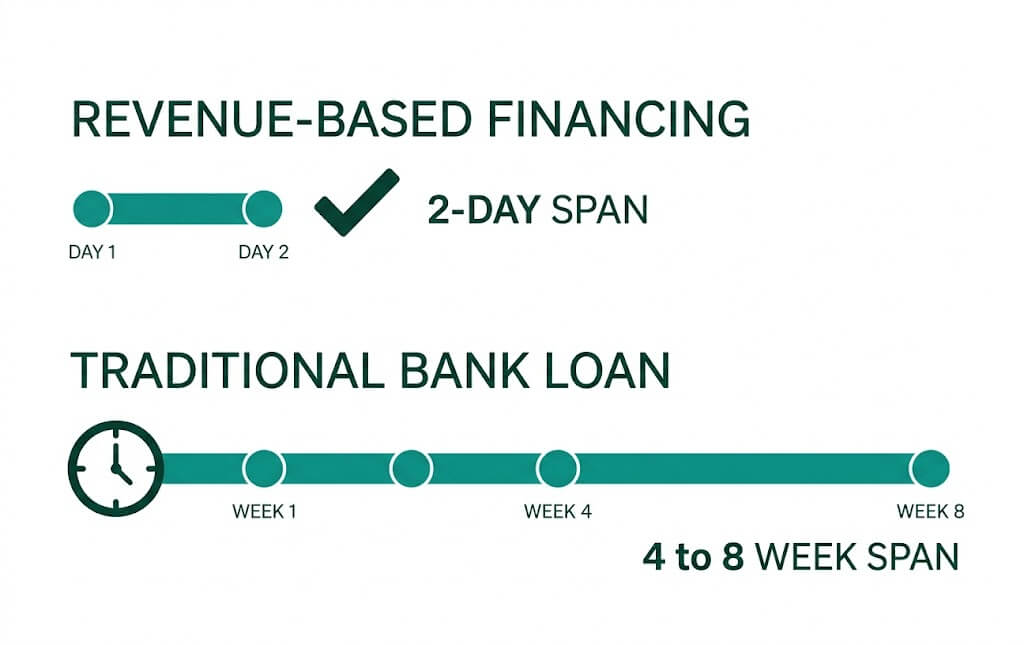
Not every form of capital helps a bonding application equally, and this is where contractors most often get bad advice. A quick look at Platform Funding’s full range of financing options shows why the structure of the capital, not just the amount, is what a surety underwriter reacts to. A traditional line of credit for contractors can help, but approval timelines of four to eight weeks mean the capital often doesn’t land before a bid deadline, and unused-but-approved credit lines don’t always get full credit from a surety underwriter the way cash on the balance sheet does. Equipment leasing solves a different problem entirely; it preserves cash for equipment purchases but doesn’t add liquidity to a working capital calculation the way direct funding does. Some contractors also weigh SBA loans against alternative financing at this stage, though SBA timelines rarely align with a bid deadline.
Revenue-based financing sits in a different spot: funding lands in 24 to 48 hours for qualifying businesses, the capital hits the balance sheet as liquid working capital immediately, and repayment structured around revenue avoids the current-liability drag that a rigid loan term can create. For a contractor watching a bidding window close, that speed difference is often the entire decision. A construction line of credit remains useful for ongoing operational flexibility, and a business loan still makes sense for a single large capital need, but when the specific goal is moving a bonding number before a deadline, the structure and speed of the capital both matter more than the label on the product.
Who Qualifies for This Kind of Financing
Platform Funding requires a minimum of 6 months in business and $10,000 or more in average monthly revenue to qualify, with no minimum credit score threshold that automatically disqualifies an otherwise healthy contracting business. This is meaningfully different from a bank’s underwriting, which weighs personal and business credit history heavily and often takes weeks to reach a decision regardless of how strong the contractor’s project pipeline looks, which is also why contractors researching construction financing options for bad credit tend to land here first. A contracting business doesn’t need to be enormous to qualify. It needs a consistent revenue history and a clear reason the capital will move the business forward, whether that’s bonding capacity, payroll continuity, or equipment downtime that’s costing more in lost jobs than the financing would cost in fees.
Over $2 billion has been funded to more than 30,000 businesses through this model, with an A+ Better Business Bureau rating and a 4.9 out of 5 Trustpilot score from 575 verified reviews. For contractors, that track record matters because bonding and lending decisions both come down to trust in a way that’s hard to fake with paperwork alone.
Get Working Capital Before Your Next Bonding Review
Most contractors complete the application in under 15 minutes. No collateral required. Your dedicated account manager reviews your application personally.
Start Your Application →Working Capital Requirements a Surety Will Actually Verify
Sureties don’t take a contractor’s word for their working capital position. They request current financial statements, often CPA-reviewed or CPA-compiled depending on program size, along with a work-in-progress schedule showing all active and upcoming jobs. Federal law requires bonding on many public construction contracts above certain dollar thresholds, a requirement the U.S. Small Business Administration’s guidance on surety bonds outlines alongside SBA’s own bond guarantee programs for smaller contractors, which means the working capital conversation isn’t optional for any contractor planning to compete for public work. The Federal Trade Commission’s guidance on business credit and financing covers the broader disclosure and terms a contractor should expect to see spelled out clearly in any financing offer, bonded work or not. This is also where financing timed a few weeks ahead of a bonding renewal, rather than reactively after a bid is lost, makes the biggest difference. A checklist of what to prepare before applying for financing overlaps heavily with what a bonding review will ask for, which is worth doing once rather than twice.
How Larger Bonding Capacity Changes What a Contractor Can Bid
The practical effect of moving a bonding ceiling from $1 million to $2 million isn’t abstract. It’s the difference between competing only for smaller subcontracts and being able to prime a mid-sized commercial or public project outright. Contractors who reach that threshold also tend to see reduced dependence on delayed receivables from any single job, since a larger bonding capacity usually comes with a more diversified project pipeline rather than betting the business on one contract at a time.
It also changes negotiating positions with general contractors and owners further up the chain. A subcontractor or GC that can show a bonding capacity comfortably above the job size being discussed looks like a lower-risk partner, which shows up in win rates on competitive bids even before price is discussed. This is one of the less obvious ways working capital helps scale operations faster for a contracting business, specifically beyond the direct cash flow benefit.
There’s a compounding effect worth planning around, too. A contractor who moves from a $1 million to a $2 million bonding ceiling isn’t just eligible for larger individual jobs; the higher aggregate program limit that comes with it usually allows more total bonded work to run at once, since the aggregate figure caps the combined value of every active bonded project rather than just the largest one. That shift lets a growing contractor run two or three mid-sized jobs in parallel instead of sequencing them one at a time, which is often the real difference between a business that grows steadily and one that stays capped at the same revenue range year after year regardless of how many bids it wins.
How to Apply
Platform Funding’s process, laid out in full on the how it works page, starts with a short application and a review of recent business bank statements rather than a lengthy underwriting file. Most qualifying contractors receive a funding decision within 24 to 48 hours, and funds are available immediately once approved and accepted. There’s no requirement to specify bonding as the intended use, though contractors working toward a bonding review should time the application at least two to three weeks ahead of when the surety will pull updated financials, giving the funds time to settle and reflect cleanly on a current balance sheet. Contractors who want the fuller mechanics can review how to get a construction business loan, see how financing works across the industries Platform Funding serves, or explore funding options directly to see what’s available for their specific revenue and business history.
Get Your Contractor Capital in 24-48 Hours
Most contractors complete the application in under 15 minutes. No collateral required. Your dedicated account manager reviews your application personally.
Start Your Application →FAQ
What is bonding capacity in construction?
Bonding capacity is the maximum dollar value of construction work a surety company will guarantee for a contractor at any given time. It’s based primarily on the contractor’s working capital, net worth, and history of completing projects successfully, and it functions independently of whatever credit or borrowing limits a bank has extended to the same business.
How is bonding capacity different from a bank credit limit?
A bank credit limit is based on personal and business credit history, collateral, and debt-to-income calculations. Bonding capacity is based on a surety’s assessment of a contractor’s financial strength and project track record, typically measured through a multiplier applied to working capital. A contractor can have excellent bank credit and still face a low bonding ceiling if working capital is thin.
How much does working capital affect bonding capacity?
Most sureties apply a multiplier, commonly in the range of 10 to 15 times working capital, to determine a contractor’s single-job and aggregate bonding limits. Increasing working capital by even a modest amount can move a contractor’s bonding ceiling by a significant multiple of that increase, which is why targeted financing ahead of a bonding review is a common strategy among growing contractors.
Can a business loan hurt my bonding capacity instead of helping it?
Yes, depending on the structure. A surety calculates working capital as current assets minus current liabilities, and a fixed-term loan with large near-term payment obligations can increase current liabilities enough to offset the benefit of the cash received. Revenue-based financing, which doesn’t carry a fixed monthly payment structure, is less likely to create this offsetting effect.
How fast can financing actually improve my bonding position?
Funding through Platform Funding is typically available within 24 to 48 hours for qualifying businesses. Contractors should still allow two to three weeks between receiving funds and a bonding review, since the capital needs to appear on a current financial statement before a surety underwriter will factor it into a working capital calculation.
Do I need a minimum credit score to qualify for this type of financing?
There’s no automatic credit score cutoff. Approval is based primarily on business revenue history and time in business, with a minimum of 6 months operating and $10,000 or more in average monthly revenue. This makes it accessible to contractors whose personal credit doesn’t reflect the actual health of their business.
What documents does a bonding company usually require?
Most sureties request current financial statements, which may need to be CPA-reviewed or compiled depending on the size of the bonding program, along with a work-in-progress schedule detailing all active and upcoming contracts. Many public construction contracts above certain dollar thresholds require bonding under federal law, and the SBA’s own guidance on surety bonds outlines this alongside its bond guarantee programs for smaller contractors, making this documentation a standard part of competing for public work.
How is revenue-based financing different from other short-term financing with fixed daily payments?
Revenue-based financing structures repayment around a percentage of ongoing business revenue rather than a fixed daily or weekly payment. Platform Funding’s model is built around business bank statement review rather than fixed payment schedules, and repayment adjusts with the pace of the business’s actual revenue.
Can subcontractors use this same strategy, or is it only for general contractors?
Subcontractors face the same bonding constraints as general contractors when a job requires a bond, and the same working capital math applies. A subcontractor showing bonding capacity comfortably above a given job’s size is often viewed as a lower-risk partner by the GC awarding the work, which can influence competitive bid outcomes.
What happens if I don’t act on a bonding capacity issue before a bid deadline?
A contractor whose bonding capacity falls short of a bid’s requirement typically has to pass on the opportunity entirely, since most owners and GCs won’t accept a bid without confirmed bonding in place. This is different from a financing shortfall, which sometimes allows for partial workarounds; bonding capacity is closer to a hard gate.
How much funding is typically available through this program?
Platform Funding offers funding from $5,000 to $3,000,000, depending on the business’s revenue and qualifications. Contractors working on a bonding capacity strategy typically request an amount calculated backward from their target bonding ceiling and the surety’s stated multiplier, rather than a round number.
Does this financing require collateral like equipment or real estate?
No collateral is required. Approval is based on business revenue and operating history rather than pledged assets, which is a meaningful difference from many bank-based options that require a contractor to put equipment, vehicles, or property up as security.