


Revenue-based financing provides business capital with repayments tied directly to monthly revenue performance. Unlike fixed-payment loans, RBF adjusts with sales fluctuations and requires no collateral or equity sacrifice. Platform Funding offers $5,000 to $500,000 with 24-48 hour approval for qualified businesses.
The Capital Access Problem Facing Small Businesses Today
Traditional bank financing continues to present significant challenges for small business owners in 2026. Large banks approved only 14.6% of small business loan applications according to the Small Business Credit Survey, while overall full approval rates hover around 57% across all lender types. These institutions maintain strict credit requirements, demand extensive collateral, and impose lengthy approval processes lasting weeks or months. For businesses needing capital to seize time-sensitive opportunities, this timeline represents lost revenue and competitive disadvantage.
E-commerce businesses preparing seasonal inventory builds cannot wait six weeks for loan decisions. Service companies scaling operations need immediate access to working capital. Restaurant owners planning equipment upgrades require funding that adapts to variable monthly sales rather than fixed payments that ignore business cycles.
Revenue-based financing addresses these challenges through a fundamentally different approach to business lending. This financing model prioritizes business performance over personal credit scores, provides funding decisions within 24-48 hours, and structures repayments as a percentage of actual sales rather than fixed monthly obligations.
Understanding Revenue-Based Financing Mechanics
Revenue-based financing operates through a straightforward mechanism. Lenders provide capital to businesses in exchange for a predetermined percentage of future monthly revenues until the total repayment amount reaches completion. This percentage typically ranges between 5% and 15% of gross monthly sales, with the specific rate determined by factors including business history, revenue stability, and industry risk profile.
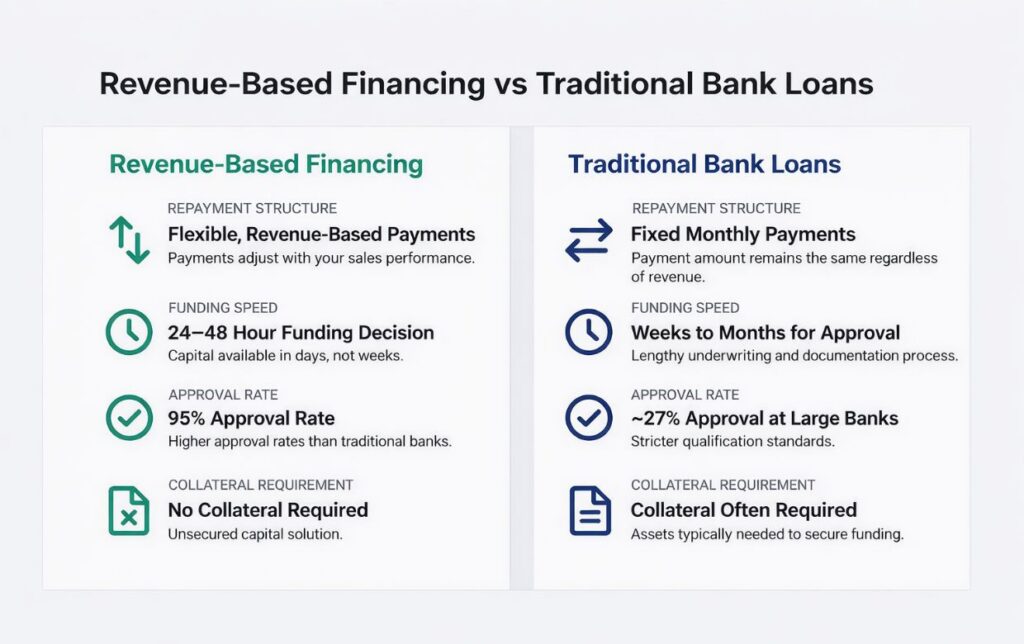
The repayment structure creates inherent flexibility. During high-sales months, businesses naturally repay larger amounts. During slower periods, repayment obligations decrease proportionally. This alignment between revenue performance and debt service prevents cash flow strain common with traditional fixed-payment loans.
The Daily Remittance Process
Most revenue-based financing arrangements utilize automated daily ACH collection. Rather than waiting for month-end invoicing cycles, the lender receives a small percentage of daily credit card and debit card sales directly through point-of-sale integration or bank account access. This daily collection mechanism provides lenders with real-time visibility into business performance while reducing monthly payment shock for borrowers.
For a business generating $100,000 in monthly revenue with a 10% collection rate, daily remittances average approximately $330 per business day. This gradual collection proves less disruptive to operations than a single $10,000 monthly payment withdrawal.
How RBF Differs From Traditional Loans
Traditional term loans establish fixed monthly payments regardless of business performance. A company experiencing seasonal slowdowns or unexpected revenue decline still owes the same payment amount, potentially forcing difficult decisions between debt service and operational expenses like payroll or inventory replenishment.
Revenue-based financing eliminates this pressure. The percentage-based structure means slower months generate proportionally lower repayment amounts. This flexibility proves particularly valuable for seasonal businesses managing cyclical revenue patterns or companies in high-growth phases experiencing temporary cash flow challenges.
The True Cost of Revenue-Based Financing
Understanding the complete cost structure requires looking beyond simple interest rate comparisons. Revenue-based financing typically uses a factor rate rather than annual percentage rate (APR) to express pricing. A factor rate of 1.25 means you repay $1.25 for every $1.00 borrowed. On a $100,000 advance, total repayment equals $125,000, representing $25,000 in financing costs.
Factor Rates Versus APR
Factor rates appear lower than equivalent APR calculations, but direct comparison requires careful analysis. A factor rate between 1.15 and 1.35 typically translates to an APR ranging between 18% and 45%, depending on repayment speed. The faster your business repays the advance through higher daily remittances, the higher the effective APR becomes.
This counterintuitive dynamic means successful, high-revenue businesses often pay higher effective rates than slower-growing companies. However, the trade-off provides access to capital that scales with business needs without fixed payment obligations threatening operational stability.
Hidden Costs and Fee Structures
Transparent lenders clearly disclose total repayment obligations upfront. Platform Funding maintains this transparency standard, ensuring businesses understand complete costs before accepting funding. Reputable revenue-based financing providers avoid prepayment penalties, allowing businesses to clear obligations early without additional fees when cash flow permits.
Some providers charge origination fees ranging between 2% and 5% of the funded amount. Others build these costs into the factor rate itself. Administrative fees for daily ACH processing should be minimal or nonexistent with modern automated systems.
Qualification Requirements for Revenue-Based Financing
Revenue-based financing maintains more accessible qualification standards compared to traditional bank loans. This accessibility stems from the self-securing nature of the product. Because repayment comes directly from daily revenues, lenders focus primarily on revenue consistency rather than balance sheet strength or extensive collateral requirements.
Minimum Business Age and Revenue Thresholds
Most lenders require businesses to demonstrate at least 12 months of operating history. This timeframe provides sufficient data to assess revenue patterns, seasonal fluctuations, and overall business viability. Platform Funding adheres to this standard while maintaining flexibility for particularly strong candidates with slightly shorter operating histories.
Monthly revenue thresholds typically start at $10,000 per month, though many lenders prefer seeing $25,000 or higher for optimal qualification. These minimums ensure the business generates sufficient daily sales to support comfortable repayment percentages without constraining operations.
Credit Requirements and Bank Statement Analysis
While revenue-based financing accommodates businesses with less-than-perfect credit, lenders still review both business and personal credit histories. Most providers accept credit scores starting in the 550-600 range, significantly below the 680+ requirements common with traditional bank loans.
The primary underwriting focus centers on bank statement analysis covering the most recent three to six months. Underwriters examine deposit consistency, account balance trends, returned payment frequency, and overall financial health. This documentation-light approach eliminates the extensive financial statement requirements that slow traditional lending approvals.
Industry Considerations
Certain industries align particularly well with revenue-based financing structures. Businesses with consistent credit card transaction volumes prove ideal candidates. This includes retail operations, restaurants, e-commerce companies, and service businesses with regular recurring revenue.
Healthcare practices and legal service providers often qualify despite longer payment cycles, provided they demonstrate stable revenue patterns. Construction companies and manufacturers with project-based revenue may face additional scrutiny due to less predictable cash flow patterns.
When Revenue-Based Financing Makes Strategic Sense
Revenue-based financing serves specific business situations particularly well. Understanding optimal use cases helps businesses determine if this funding model aligns with their growth strategy and financial situation.
Inventory and Seasonal Preparation
Retail businesses preparing for peak seasons benefit significantly from revenue-based financing. The ability to secure inventory financing quickly without lengthy approval processes enables timely stock purchases ahead of critical selling periods. As inventory sells and revenue increases, the higher daily collections naturally align with improved cash position.
E-commerce businesses facing similar seasonal patterns appreciate the speed and flexibility. Platform Funding’s 24-48 hour funding timeline allows businesses to capitalize on supplier discounts or time-sensitive opportunities that traditional lending timelines would miss.
Marketing Campaign Funding
Revenue-based financing provides ideal capital for businesses launching significant marketing initiatives. The expected revenue increase from successful campaigns naturally covers the higher repayment amounts during peak response periods. This creates a self-funding cycle where marketing investment drives revenue that services the debt used to fund the campaign.
Service businesses expanding client acquisition efforts appreciate this alignment. The financing structure matches payment obligations to the results generated by the funded activities, reducing risk compared to fixed-payment obligations that persist regardless of campaign performance.
Bridge Financing for Growth Transitions
Companies transitioning between growth stages often face temporary cash flow gaps despite strong underlying business fundamentals. Revenue-based financing fills these gaps without the equity dilution associated with venture capital or the restrictive covenants common in traditional lending.
Growing your business without diluting equity preserves founder ownership while accessing necessary growth capital. This approach proves particularly valuable for profitable businesses that need working capital to fund growth but prefer avoiding equity investors.
Equipment Purchases and Upgrades
While equipment leasing remains the traditional approach for equipment financing, revenue-based financing offers advantages for certain situations. Businesses needing multiple equipment types or preferring ownership over leasing arrangements benefit from the flexibility.
Restaurant equipment purchases often combine well with revenue-based financing. The equipment improvements drive increased revenue through enhanced capacity or improved customer experience, with the revenue growth naturally supporting repayment obligations.
Comparing Revenue-Based Financing to Alternative Funding Models
Small businesses face numerous funding options in 2026. Understanding how revenue-based financing compares to alternatives helps identify the optimal solution for specific situations.
Revenue-Based Financing Versus Traditional Bank Loans
Traditional bank loans offer lower interest rates and longer repayment terms compared to revenue-based financing. However, this cost advantage comes with significant trade-offs. Bank loans require extensive documentation, lengthy approval processes, strict credit requirements, and often collateral pledges that put business or personal assets at risk.
The speed and approval rate advantages of revenue-based financing offset higher costs for businesses that value time-to-funding and qualification accessibility. Platform Funding’s 95% approval rate contrasts sharply with the 14.6% approval rate at large banks according to the Small Business Credit Survey, or the 57% overall approval rate across all traditional lender types.
Revenue-Based Financing Versus Lines of Credit
Business lines of credit provide revolving access to capital with interest charges only on drawn amounts. This flexibility makes lines of credit excellent tools for managing ongoing working capital needs and unexpected expenses.
Revenue-based financing better serves one-time capital needs or businesses that prefer the discipline of term financing over revolving credit. The structured repayment schedule ensures debt retirement within a predictable timeframe, while lines of credit can tempt businesses into persistent debt cycles.
Revenue-Based Financing Versus Equity Financing
Equity financing requires no repayment but permanently dilutes ownership stakes. Non-dilutive financing options preserve founder control while still providing growth capital.
Revenue-based financing maintains this non-dilutive advantage while adding defined endpoint clarity. Once repayment reaches completion, the business owes nothing further. Equity investors maintain perpetual ownership stakes and ongoing influence over business decisions.
The Application and Approval Process
Revenue-based financing emphasizes speed and simplicity throughout the application process. Understanding what to expect helps businesses prepare for efficient processing.
Documentation Requirements
The documentation list remains significantly shorter than traditional loan applications. Typical requirements include:
Business bank statements covering the most recent three to six months provide the primary underwriting data. These statements reveal revenue patterns, expense management, and overall financial health.
Business formation documents prove legal entity status and ownership structure. This includes articles of incorporation, operating agreements, or partnership documents.
Government-issued identification for all business owners with significant ownership stakes ensures proper identity verification and regulatory compliance.
Credit authorization allows lenders to pull business and personal credit reports. While credit plays a smaller role in revenue-based financing decisions, it remains part of the overall risk assessment.
Timeline and Decision Process
Platform Funding’s streamlined process delivers preliminary decisions within hours of receiving complete documentation. The technology-driven underwriting system analyzes bank statement data rapidly, identifying revenue trends and qualification factors without manual review delays.
Approved businesses typically receive funding within 24-48 hours of final approval and contract execution. This speed proves critical for businesses facing time-sensitive opportunities or urgent capital needs.
Funding Amount Determination
Lenders calculate maximum funding amounts based on monthly revenue performance. Most providers offer between two and six times average monthly revenue as the maximum advance amount. A business averaging $50,000 in monthly revenue might qualify for funding between $100,000 and $300,000, depending on additional factors like credit history, business age, and industry risk profile.
Platform Funding offers funding ranging between $5,000 and $500,000, accommodating businesses at various growth stages and capital need levels.
Managing Your Revenue-Based Financing Relationship
Successfully managing revenue-based financing requires understanding the ongoing relationship dynamics and repayment optimization strategies.
Monitoring Daily Collections
Most lenders provide online portals showing real-time collection activity and remaining balance calculations. Regular monitoring helps businesses understand how daily sales translate to repayment progress and projected payoff timelines.
Understanding these patterns enables better cash flow planning. Businesses can anticipate higher collections during peak sales periods and adjust operational spending accordingly during slower phases when collections decrease proportionally.
Communication With Your Lender
Platform Funding assigns dedicated account managers to each client, ensuring personalized support throughout the funding relationship. This relationship-focused approach contrasts with automated-only competitors that provide minimal human interaction.
Proactive communication proves valuable when businesses face unexpected challenges. While revenue-based financing naturally adjusts to revenue fluctuations, significant disruptions may warrant direct conversation about temporary modifications or workout arrangements.
Planning for Renewal Funding
Businesses that successfully complete initial revenue-based financing arrangements often qualify for renewal funding at improved terms. The established relationship and proven repayment history reduce lender risk, potentially resulting in lower factor rates or higher funding amounts on subsequent advances.
This creates an opportunity for businesses to establish financing relationships that support multiple growth phases. Planning renewal timing to coincide with major growth initiatives or seasonal preparation periods optimizes the strategic value of available capital.
Common Misconceptions About Revenue-Based Financing
Several misunderstandings about revenue-based financing persist in the market. Clarifying these misconceptions helps businesses make informed funding decisions.
Misconception: Revenue-Based Financing Equals Merchant Cash Advances
While structurally similar, revenue-based financing and merchant cash advances differ in important ways. True merchant cash advances involve purchasing future credit card receivables, technically representing a sale rather than a loan. Revenue-based financing structures as debt arrangements with percentage-based repayment terms.
This distinction affects regulatory treatment and consumer protections. Reputable lenders clearly communicate the product structure and avoid confusing terminology designed to obscure true costs.
Misconception: Only Desperate Businesses Use Alternative Lending
This outdated perception ignores the strategic advantages revenue-based financing offers qualified businesses. Many profitable companies with strong credit profiles choose revenue-based financing specifically for its speed and flexibility advantages, not as a last resort after bank rejections.
The changing landscape of business funding reflects increasing recognition that different financing tools serve different strategic purposes. Optimal capital structure often includes multiple product types deployed for specific situations.
Misconception: Factor Rates Hide True Costs
Transparent lenders like Platform Funding clearly disclose total repayment obligations upfront, ensuring businesses understand complete costs before accepting funding. While factor rate presentation differs from APR calculations, the total dollars owed remains unambiguous in clear disclosures.
Businesses should demand this transparency and avoid providers that obscure true costs through confusing fee structures or misleading comparisons.

Is Revenue-Based Financing Right for Your Business?
Revenue-based financing serves as a powerful tool in the right situations. Businesses should consider this funding model when:
Speed matters. Time-sensitive opportunities or urgent capital needs require funding decisions measured in hours rather than weeks. Platform Funding’s 24-48 hour timeline accommodates situations where traditional lending timelines represent missed opportunities.
Flexibility provides value. Businesses with variable revenue patterns benefit from repayment structures that adjust with sales performance. Fixed-payment obligations during slow periods create unnecessary financial stress that percentage-based collections avoid.
Traditional approval poses challenges. Companies with credit profiles below bank standards but strong revenue performance find accessible qualification through revenue-based financing. The 95% approval rate reflects the product’s inclusive design for businesses banks often decline.
Collateral remains unavailable. Many growing businesses lack real estate or significant equipment to pledge as loan collateral. Revenue-based financing requires no asset pledges, removing this common qualification barrier.
Equity preservation matters. Founders unwilling to sacrifice ownership stakes or board control appreciate the non-dilutive nature of debt financing generally and revenue-based financing specifically.
Taking the Next Step: Applying for Revenue-Based Financing
Businesses ready to pursue revenue-based financing should prepare by gathering the necessary documentation and understanding their funding needs clearly. Calculate specific capital requirements, identify the planned deployment of funds, and develop projections showing how the investment will drive revenue growth or operational improvements.
Review your business bank statements through the lender’s perspective. Strong, consistent deposits with minimal returned payments and healthy account balances improve qualification likelihood and potential funding amounts.
Research potential lenders carefully. Platform Funding’s established reputation, transparent pricing, and relationship-focused approach provide the foundation for productive financing partnerships. Our dedicated account managers ensure personalized support throughout the application process and beyond.
Platform Funding: Your Revenue-Based Financing Partner
Platform Funding has facilitated over $2 billion in funding to more than 30,000 businesses since inception. Our revenue-based financing solutions provide small and medium businesses with the growth capital they need on terms that align with their actual business performance.
Our competitive advantages include:
Lightning-fast funding decisions. Our 24-48 hour approval and funding timeline ensures your business can act on opportunities without delay.
Industry-leading approval rates. Our 95% approval rate reflects our inclusive approach and technology-driven underwriting that looks beyond traditional credit metrics.
Transparent pricing. We clearly disclose all costs upfront, ensuring you understand the complete financial commitment before accepting funding.
Dedicated account managers. Your assigned account manager provides personalized guidance throughout your funding relationship, offering ongoing business support beyond just capital provision.
Flexible funding amounts. Our $5,000 to $500,000 funding range accommodates businesses at various stages, with renewal opportunities as your capital needs grow.
Revenue-aligned repayments. Our percentage-based collection structure naturally adjusts to your sales performance, protecting cash flow during slower periods while accelerating payoff during high-revenue months.
Frequently Asked Questions About Revenue-Based Financing
What is the typical approval rate for revenue-based financing?
Revenue-based financing generally maintains significantly higher approval rates than traditional bank lending. While specific rates vary by provider, big banks approved only 14.6% of small business loans as of recent Federal Reserve Small Business Credit Survey data. Alternative lenders, which include revenue-based financing providers, approved approximately 30% of applications in September 2023. Platform Funding’s 95% approval rate reflects our technology-driven underwriting approach that prioritizes revenue performance over traditional credit metrics.
How fast can I receive funding through revenue-based financing?
Revenue-based financing provides significantly faster funding compared to traditional bank loans. Most revenue-based financing providers offer quick access to capital, with expedited procedures particularly helpful for entrepreneurs and growing businesses. Platform Funding delivers preliminary decisions within hours of receiving complete documentation, with funding typically arriving in business accounts within 24-48 hours of final approval.
What percentage of my revenue will I need to repay?
Revenue-based financing typically involves repaying between 5% and 15% of monthly gross revenue, with the specific percentage determined by factors including business history, revenue stability, and industry risk profile. Repayment caps typically range between 1.5x and 3x the funding amount. Your specific rate depends on your business profile and funding terms.
What is the cost of revenue-based financing compared to traditional loans?
Revenue-based financing uses factor rates rather than APR, typically ranging between 1.15 and 1.35, which translates to an effective APR between 18% and 45% depending on repayment speed. While higher than traditional bank loan rates of 7-12% APR, the flexibility and accessibility often justify the additional cost for businesses that cannot qualify for bank financing or need faster funding decisions.
What are the minimum qualifications for revenue-based financing?
Most revenue-based financing providers require at least 12 months of operating history and minimum monthly revenues of $10,000 to $25,000. Revenue-based financing typically starts at amounts as low as $10,000 and bases approval more on a company’s robust sales history and consistent annual revenue rather than solely on credit scores. Credit score requirements are more flexible than traditional bank lending, with many providers working with scores as low as 550-600.
How does revenue-based financing differ from merchant cash advances?
While structurally similar, revenue-based financing and merchant cash advances differ in important ways. True merchant cash advances involve purchasing future credit card receivables, technically representing a sale rather than a loan. Revenue-based financing structures as debt arrangements with percentage-based repayment terms. Both use daily or weekly collection mechanisms tied to sales performance, but revenue-based financing typically offers more transparent pricing and regulatory protections.
Can I get revenue-based financing with bad credit?
Yes, revenue-based financing accommodates businesses with less-than-perfect credit. Businesses with credit challenges can often qualify based on strong revenue performance. While lenders still review credit histories, they prioritize consistent revenue patterns and bank statement analysis over credit scores. This makes revenue-based financing accessible to businesses that traditional banks decline.
What industries work best with revenue-based financing?
IT and telecommunications accounted for the largest share of revenue-based financing in 2023, with significant adoption among B2B, SaaS companies, and technology service firms with high recurring revenue. Retail businesses, e-commerce companies, restaurants, and service businesses with regular credit card transactions also align well with this financing model. Businesses with consistent revenue streams see the most benefit.
Is revenue-based financing growing in popularity?
Yes, the revenue-based financing market is experiencing significant growth. The global revenue-based financing market was valued at $4.75 billion in 2025 and expanded to $5.38 billion in 2026, with projections to reach $16.5 billion by 2035, exhibiting a CAGR of 13.26%. Nearly 71% of US startups prefer revenue-linked financing instead of equity dilution, reflecting increasing recognition of this financing model’s strategic advantages.
Can I repay revenue-based financing early?
Most reputable revenue-based financing providers, including Platform Funding, allow early repayment without prepayment penalties. Some providers even offer early repayment discounts that reduce the total amount owed if you clear the obligation ahead of schedule. This flexibility gives businesses control over their debt management strategy when cash flow permits accelerated repayment.
Get Revenue-Based Financing for Your Small Business
Ready to access growth capital that aligns with your business performance? Platform Funding’s revenue-based financing solutions provide the speed, flexibility, and approval accessibility your business needs to seize opportunities and achieve growth goals.
Our team of alternative lending specialists stands ready to evaluate your unique situation and determine optimal funding solutions. The application process takes minutes to start, with preliminary decisions delivered within hours.
Visit platformfunding.com to begin your application or speak with a funding specialist who can answer questions and guide you through the process. Platform Funding transforms the business financing experience through technology, transparency, and relationship-focused service that puts your success first.
Stop waiting for traditional bank approvals that may never come. Access the capital your business deserves through revenue-based financing structured around your actual performance, not arbitrary credit formulas designed for different business eras. Your growth journey deserves a financing partner that understands modern business realities and provides solutions that work.
Contact Platform Funding today and experience business financing designed for your success.