


You’ve closed the books on 2025. The tax filings are complete, and you know exactly where your business stands. Now comes the critical decision: how will you turn those insights into growth in 2026?
March represents a strategic inflection point for small business owners. Your growth plans are taking shape, but planning without capital access is incomplete. The businesses that secure growth capital in Q1 consistently outperform those who wait until mid-year, when opportunities have already passed.
The math is straightforward: growth initiatives require 90 days from capital deployment to full productivity. Secure funding in March, and your team, systems, and campaigns reach peak performance in June—right as Q2 revenue accelerates. Wait until May, and you’ll have missed the spring season entirely.
Why Q1 Timing Determines Your Growth Trajectory
Most businesses generate 40-45% of annual revenue during Q2 and Q3, with spring and summer representing peak performance periods for many industries. For businesses with seasonal revenue patterns, missing this window doesn’t just delay growth—it fundamentally changes your year’s trajectory.
Consider the operational timeline for typical growth initiatives:
Hiring new team members requires 60-90 days from capital decision to productivity. Post positions in March, conduct interviews through April, complete onboarding in May, and achieve meaningful contribution by June.
Marketing campaigns need 45-60 days for planning, implementation, and optimization. Launch in April with March funding, and you’ll capture the full spring demand cycle.
Equipment purchases and system implementations often involve 30-90 day lead times. Order in March, receive and install through April and May, and operate at full capacity for peak season.
The alternative timeline reveals the cost of delay. Apply for traditional bank financing in March, wait 3-6 weeks for a decision, and receive funding in late May if approved. Your initiatives launch in June or July, reaching productivity in August or September—after peak season has passed.
This isn’t theoretical. When businesses secure working capital during Q1, they position themselves to capture seasonal demand that drives annual performance. Revenue-based financing addresses this timing challenge directly with 24-48 hour funding decisions.
Three Strategic Growth Capital Categories
Growth capital isn’t monolithic. Different business objectives require different investment levels and generate returns on distinct timelines.
Q1 2026 growth capital planning involves securing funding in March for April deployment, ensuring full productivity by June during peak season. Calculate capital needs across expansion ($50K-$250K), operational scaling ($25K-$100K), and marketing investment ($15K-$75K). Revenue-based financing provides 24-48 hour decisions with flexible repayment adjusting to business performance.
Expansion Capital: $50,000 to $250,000
Expansion capital funds new locations, new markets, or additional business lines. You’re creating new revenue streams rather than optimizing existing operations.
A retail business with one established location generating $850,000 annually might identify a second location opportunity. The capital requirement for retail expansion breaks down across build-out and equipment ($85,000), inventory ($45,000), and initial marketing ($18,000)—totaling $148,000.
With revenue-based financing at 12% of combined sales, repayment adjusts automatically. During slower months, the business might remit $8,200. During peak periods when both locations generate strong sales, payments increase to $13,700. The percentage remains constant while dollar amounts flex with actual performance.
First-year results for well-executed retail expansion typically show the second location reaching 70-75% of the original location’s revenue, though individual results vary based on market conditions and execution. Combined revenue increases substantially, and the recurring value compounds annually.
Expansion capital generally delivers ROI within 12-24 months as you’re building infrastructure and market presence from the ground up.
Operational Scaling Capital: $25,000 to $100,000
This category supports team growth, systems implementation, and infrastructure that amplifies your existing business model without fundamental changes to what you sell or how you serve customers.
Professional services firms encounter this challenge frequently. A consulting practice with three employees generating $480,000 annually faces a founder bottleneck when 60% of billable work depends on the owner’s time. Service business financing addresses revenue growth constraints when more founder hours for delivery mean less time for business development.
Operational scaling capital addresses this with strategic investments: hiring two mid-level consultants to handle delivery work, implementing CRM and project management systems to improve efficiency, and allocating budget for lead generation while the founder focuses on growth.
The total investment might reach $73,000, covering six months of runway during new hire ramp-up. Revenue-based repayment at 11% of monthly revenue starts at $5,280 when revenue is $48,000 monthly. As consultants become productive and revenue grows to $70,000 monthly, payments rise to $7,700—affordable because cash flow increases support higher payments.
This approach typically generates ROI within 6-12 months because you’re amplifying proven operations rather than building from scratch. The freed founder capacity often drives additional revenue beyond the new hires’ direct contribution.
Marketing and Sales Investment Capital: $15,000 to $75,000
Marketing capital delivers the fastest ROI but receives insufficient attention from many business owners. This category funds customer acquisition, advertising campaigns, and sales infrastructure.
An e-commerce business generating $65,000 monthly with strong product reviews and healthy customer lifetime value demonstrates product-market fit. The constraint is insufficient marketing investment to scale customer acquisition.
Marketing capital of $52,000 might support scaling ad spend from $2,800 to $12,000 monthly, hiring a performance marketing specialist, investing in analytics and testing tools, and developing content and creative assets.
At 13% of revenue, the business pays $8,450 initially on $65,000 monthly revenue. As marketing scales revenue to $142,000 monthly, payments increase to $18,460. Higher payments correspond directly to higher revenue—the growth capital generated the increase.
Moving from $65,000 to $142,000 monthly represents $924,000 in additional annual revenue. Marketing capital typically shows ROI within 3-9 months because you’re activating channels that drive immediate customer acquisition rather than building long-term infrastructure.
Calculating Your Specific Capital Requirements
Strategic capital planning requires concrete math, not aspirational goals.
Start with your current annual revenue and target growth percentage. A business at $500,000 annually targeting 40% growth needs to reach $700,000—an increase of $200,000 or approximately $16,600 additional monthly revenue.
Break down the requirements:
For hiring: Count positions needed, calculate average salary plus 25-35% for benefits and taxes, include recruitment costs, and plan for 3-6 months of runway during productivity ramp-up.
For marketing: Determine monthly advertising spend, multiply by campaign duration, add software and tools costs, include content creation expenses, and account for agency or contractor fees if applicable.
For systems and technology: List required software and annual subscription costs, add implementation and training expenses, include hardware needs, and factor in consulting fees.
For inventory and equipment: Itemize new equipment purchases, calculate inventory requirements for expansion, add installation costs, and maintain a buffer for unexpected expenses.
For operations: Estimate facility costs for 3-6 months, include supplies and materials, add insurance and compliance requirements, and keep a working capital reserve.
The calculation formula: Total Capital Need = (Hiring Costs × 6 months) + (Marketing Costs × campaign duration) + (Systems Implementation) + (Equipment/Inventory) + (Operations Buffer for 3 months)
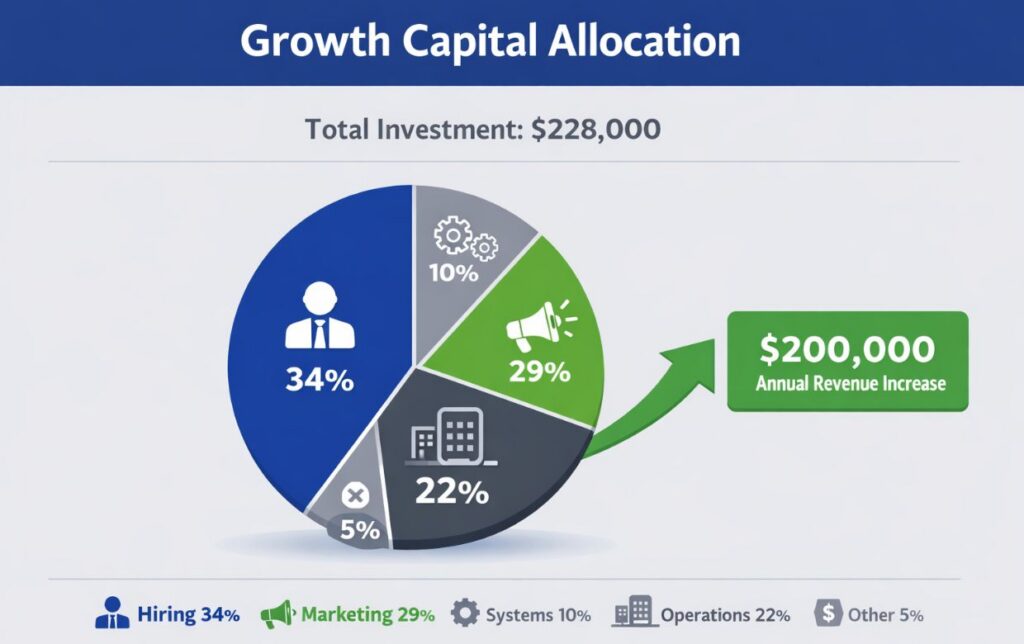
Consider a service business at $500,000 annual revenue ($41,700 monthly) targeting 40% growth to $700,000 annually ($58,300 monthly). They need an additional $16,600 per month.
The breakdown: $84,500 for two service providers for six months, including benefits; $66,000 for marketing, including ad spend and content; $23,000 for systems implementation; and $50,500 for office expansion and working capital buffer. Total: $224,000.
Platform Funding approves $230,000 with 24-48 hour decisions. Revenue-based repayment at 12% of monthly revenue means early months during ramp-up see $5,000 payments on $41,700 revenue. As growth accelerates, payments rise to $6,500-$7,000, then stabilize at $7,000-$8,000 as the business reaches its growth target.
Total repayment over approximately 20 months: $276,000. Financing cost: $46,000. Revenue increase: $200,000 annually on an ongoing basis. First-year ROI exceeds 435%.
Compare this to traditional bank timelines. Banks approve 27% of applications and require 3-6 weeks for decisions. Apply in March, hear back in late April or May, and receive funding in June. Growth initiatives launch in July and reach productivity in September—missing Q2 entirely.
The “lower” bank rate costs more in practice when timing delays revenue realization by an entire quarter.
Your Strategic March-to-December Timeline
March 2026 is your action window, not your planning window.
Right now in March: Complete your 2025 financial analysis using tax filing data. List your top three to five growth opportunities. Calculate specific capital requirements using the framework above. Apply to Platform Funding with a 10-minute application connecting your bank or accounting system for instant data review. Receive your funding decision within 24-48 hours. Learn how other businesses are preparing for Q2 with strategic financing.
April 2026: Funding arrives in your account 2-3 days after approval. Begin hiring by posting positions, interviewing candidates, and extending offers. Purchase and implement systems and technology with team training. Launch marketing campaigns and ramp up advertising spend. Order equipment and inventory, accounting for lead times. Your growth infrastructure will be operational by May 1st.
May 2026: New hires enter onboarding and training programs. Systems reach full implementation with team adoption. Marketing campaigns undergo optimization based on early performance data. Inventory arrives and gets stocked. Your team prepares for Q2 peak season with all resources in place.
June through August 2026: New team members hit full productivity. Marketing campaigns scale based on proven performance. Systems drive measurable efficiency gains. Revenue climbs 20-40% compared to last year. Growth revenue simultaneously funds repayment and generates profit.
September through October 2026: Double down on successful programs. Optimize underperforming initiatives. Plan Q4 and 2027 growth strategies. Extract maximum ROI from your Q1 capital investment with data-driven decisions.
November through December 2026: Execute the holiday season with scaled operations and infrastructure. Conduct year-end financial review and tax planning. Calculate 2027 growth capital requirements based on 2026 performance. Strong Q4 results position you for continued expansion.
The 90-day rule governs this entire timeline. Growth initiatives require approximately 90 days from capital deployment to full productivity: 30 days for setup and implementation, 30 days for training and optimization, and 30 days to reach productive operation.
Maintaining 100% Equity While Scaling
Most business owners never calculate the true cost of equity dilution when growing their business.
Venture capital operates on this principle: raise $250,000 at a $1 million valuation, surrendering 25% equity. Need a second round? Raise $500,000 at a $3 million valuation, giving up another 17%. Total dilution: 42% for $750,000 in capital.
At exit, you own 58% of your business. Sell for $1 million, and your payout is $580,000, while investors receive $420,000. You built the entire business, and they provided capital.
Revenue-based financing offers an alternative path. That same $250,000 capital requirement gets funded at $250,000. Total repayment at a 1.2x factor: $300,000. Structure: 12% of monthly revenue over 18-24 months depending on your revenue patterns. Learn more about how revenue-based financing compares to traditional loans.
At the same $1 million exit, you own 100%. No dilution. Your exit: $1,000,000. Financing cost already paid: $50,000. Net benefit compared to venture capital: $420,000 more retained value—a 72% increase.
Non-dilutive growth financing makes strategic sense when your business is profitable or approaching profitability with revenue covering repayment, you have predictable revenue patterns enabling accurate planning, your growth initiatives target 3-24 month ROI with clear returns, you value maintaining 100% ownership and decision-making control, and you’re building a sustainable business rather than pursuing venture-scale outcomes. Discover the power of non-dilutive financing.
Real-world application: A marketing agency at $680,000 in revenue needed $325,000 for expansion. They could raise from angel investors at a $1.5 million valuation, surrendering 22% equity and spending three months fundraising. Or they could receive Platform Funding approval for $325,000 in 48 hours, repaying $390,000 over 20 months at 12% of revenue while keeping 100% equity.
The agency chose non-dilutive financing. Revenue scaled to $1,280,000—88% growth. With strong operational margins typical of established agencies, they generated substantial cash flow while completely repaying the financing by month 18.
At a hypothetical exit valued at 2.5× revenue, the business would be worth $3,200,000. With venture capital, the payout would be $2,496,000 (78% ownership). With revenue-based financing, the payout is $3,200,000 (100% ownership)—a difference of $704,000.
Platform Funding’s Strategic Advantages
Speed creates a competitive advantage in growth capital deployment.
Our application requires 10 minutes for basic business information, a growth plan description, and the requested funding amount. Secure data connection takes five minutes through OAuth integration with your bank or accounting system.
Our team reviews applications within 24-48 hours with human evaluation, not just algorithmic screening. Funding arrives 2-3 days after approval via ACH transfer. Total timeline: 4-6 days from application to capital deployment.
Our 95% approval rate compared to traditional banks’ significantly lower approval rates for small business loans stems from revenue-based underwriting. Your business performance matters more than your credit score alone. Minimum requirements remain accessible: $10,000+ monthly revenue and 12+ months of operating history.
Revenue-based repayment flexibility protects cash flow during growth phases. Payments of 10-15% of monthly revenue mean lower revenue periods automatically generate lower payments. No fixed monthly payment threatens your cash flow when you’re investing in growth. No prepayment penalties allow early payoff when revenue surges.
Throughout your relationship, you receive a dedicated account manager providing growth consultation beyond just capital. Multiple funding rounds give you access to additional capital as you scale. Industry-specific expertise means we understand your business model and seasonal patterns.
A March application translates to April deployment in practice. Apply by March 15, receive funding approval by March 17, deploy capital from April 1 to 30, and achieve full productivity by June 1 during peak Q2.
The traditional bank alternative follows a different timeline. Apply March 15, wait for a decision until April 30 (six weeks if fortunate), receive funding May 7, deploy capital through May and June, and reach full productivity in August. Q2 peak season: completely missed.
The ROI impact of speed becomes evident in real scenarios. A retail marketing campaign requiring $45,000 and targeting a 4:1 ROI runs during the April-June spring peak season.
With Platform Funding’s timeline: apply March 10, approved March 12, funded March 15, campaign runs April 1-June 30, capturing full peak season. With the bank timeline: apply March 10, approved April 21, funded April 28, and the campaign runs May 15-August 15 during the off-peak period, capturing only partial ROI.
The “lower” bank rate costs more in practice when timing determines whether you capture peak season revenue.
Take Action in March 2026
March 2026 represents your strategic window. Your competitors are making these growth capital decisions now. Some will execute in April and dominate Q2. Others will delay, scramble in May, and miss their window.
Platform Funding has enabled 30,000+ businesses to deploy over $2 billion in growth capital with proven results. Fast funding decisions, flexible repayment, and strategic timing that converts planning into measurable business outcomes.
Week One (Now): Analyze 2025 financial performance. List the top three to five growth opportunities. Estimate revenue impact for each initiative. Identify which require external capital versus self-funding. Consider strategic capital moves before April tax deadlines.
Week Two: Calculate capital requirements using the framework provided. Determine the optimal funding amount for your business. Gather six months of bank statements. Review 12 months of revenue to demonstrate patterns. Apply to Platform Funding in 10 minutes online.
Week Three: Receive a funding decision within 24-48 hours. Review terms and repayment structure with your account manager. Accept terms electronically if approved. Plan capital deployment across hiring, marketing, systems, and inventory. Establish hiring, marketing, and vendor timelines.
Week Four: Receive funding via ACH 2-3 days after acceptance. Begin immediate deployment by posting jobs, launching campaigns, and purchasing equipment. Set milestone reviews at 30, 60, and 90 days. Track revenue impact starting in months two and three. Adjust and optimize based on performance data.

Ready to fund your 2026 growth? Contact Platform Funding today for a 24-48 hour funding decision. Our team evaluates your revenue performance and business model, not just your credit score. Access $5,000 to $500,000 in growth capital with revenue-based repayment adjusting to your business performance.
Call (866) 473-1455 or visit https://platformfunding.com/apply-now/
Your growth year starts in March. Strategic timing separates businesses that dominate their market from those that watch opportunities pass.