

Established manufacturers with at least 6 months in business and $10,000 or more in monthly revenue who need $5,000 to $3,000,000 to cover raw materials, labor, or overhead while fulfilling a large purchase order.
A manufacturer lands a purchase order for 50,000 units, the largest single order the business has ever received, and instead of celebrating, the owner spends the next week trying to figure out how to pay for enough raw material to actually produce it. That’s the part most financing conversations about manufacturing miss entirely: the biggest cash strain often isn’t equipment. It’s the material and labor cost of fulfilling the order that made the business successful in the first place. Platform Funding approves 95% of qualifying manufacturers for exactly this kind of order-driven capital need.
Manufacturing business loans built around bulk order and production-run financing cover the raw material, labor, and overhead costs required to fulfill a large purchase order before the customer pays, which is a different problem than financing equipment or capacity expansion. Platform Funding provides revenue-based financing sized to a manufacturer’s monthly revenue, with a 95% approval rate for qualifying businesses and funding decisions in 24 to 48 hours, built for exactly this kind of order-driven capital need. Businesses exploring the full range of revenue-based financing options can review qualification details before applying.
Why Bulk Orders Create a Bigger Gap Than Equipment Does
Most manufacturing financing content focuses on equipment: CNC machines, injection molders, and industrial ovens, the capital-intensive assets that show up clearly on a balance sheet. Equipment financing is genuinely useful, but it solves a capacity problem, not a working capital problem. A manufacturer with plenty of equipment capacity can still be unable to fulfill a large order simply because the raw materials, components, and labor needed to run that order cost more upfront than the business has sitting in cash.
This distinction matters because the two problems require different solutions. Equipment financing is typically structured as a term loan or lease tied to the useful life of the asset being purchased, often five to seven years. A bulk order’s material and labor costs are a short-term working capital need, usually resolved within 30 to 90 days once the customer pays on delivery or completion. Financing a short-term material cost with a long-term equipment loan structure is a mismatch that ties up a manufacturer’s balance sheet far longer than the actual cash need requires, and it’s a distinction covered in more depth in a broader look at operating working capital and why the definition matters beyond a textbook formula.
Manufacturers sometimes discover this mismatch the hard way, after already committing to an equipment loan or lease to cover what turned out to be a working capital shortfall rather than a capacity limitation. Once that capital is tied up in a long-term structure, it’s no longer available to flex with the next order, which can leave a business locked into fixed payments on an asset it didn’t strictly need while still short on the working capital that actually caused the original strain. Getting the diagnosis right before choosing a financing structure, capacity problem versus working capital problem, saves both the cost of the wrong product and the time spent unwinding it later.
What a Bulk Order Actually Costs Before It Pays
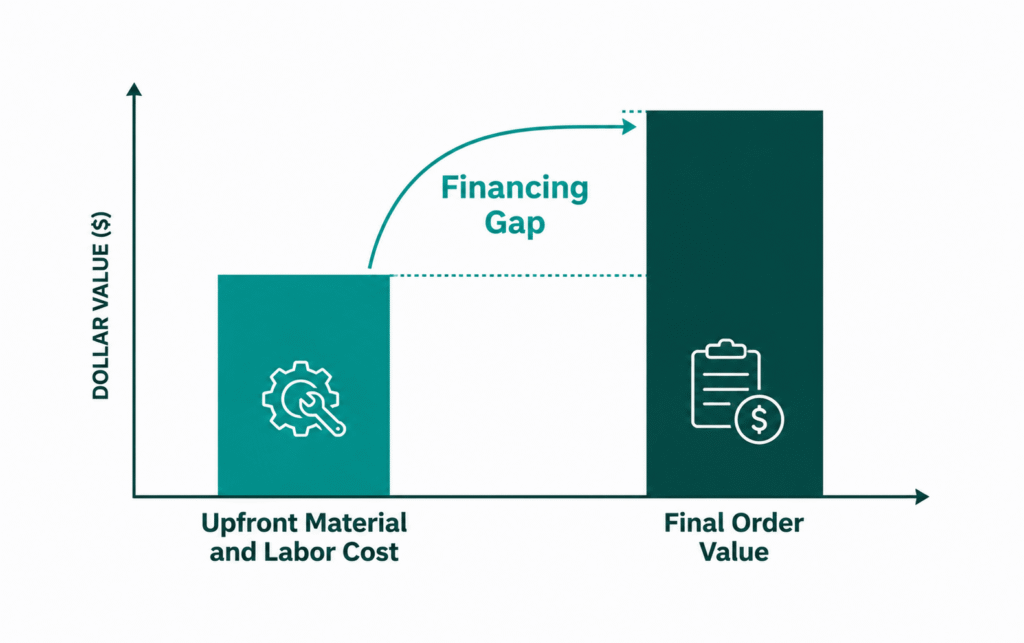
The economics of a large order are deceptively front-loaded. A manufacturer producing 50,000 units at $40 in material and labor cost per unit needs $2 million in working capital before the first unit ships, even if the finished order will ultimately sell for $3.2 million once complete. Most manufacturers don’t have $2 million in idle cash waiting for exactly this scenario, and drawing down operating cash to fund one order can leave the business unable to cover payroll or run smaller, ongoing orders simultaneously.
A precision parts manufacturer in Toledo, Ohio, faced this directly after winning a contract to supply components for a regional equipment maker. The order required $340,000 in raw material purchases and additional overtime labor before the first shipment, against a business that typically carried $90,000 in working capital for its usual order volume. A $250,000 revenue-based financing advance, funded in two days, covered the material purchase and labor costs needed to start production immediately rather than waiting weeks for a bank loan that would have pushed the delivery timeline past the customer’s deadline. The order was fulfilled on schedule, and the financing was repaid as customer payments came in over the following several months.
Timing gaps like this, where a business is fundamentally sound but temporarily short on cash because of when money moves rather than whether the business is profitable, are a common reason established businesses look beyond conventional bank loans. General guidance on small business loan and financing options is available through the U.S. Small Business Administration.
Why This Is a Cash Flow Timing Problem, Not a Credit Problem
The manufacturers who run into this most often are the ones with the strongest track records, not the weakest. A business with a reliable customer base and healthy margins is exactly the kind of business that gets offered larger orders, and larger orders are exactly what strains working capital the hardest. This is a fundamentally different situation than a manufacturer struggling with delayed receivables after delivery. The bulk order problem happens before delivery, when the manufacturer has already committed to material and labor costs but hasn’t yet produced anything a customer can pay for.
Traditional bank financing evaluates this scenario slowly. A term loan application for $250,000 tied to a single purchase order often takes four to eight weeks to underwrite and fund, by which point the order’s production window may have already closed or the customer may have moved to a competitor who could commit faster. Revenue-based financing evaluates the manufacturer’s existing revenue and deposit history rather than underwriting a single transaction, which is why funding can move in days instead of weeks when a production deadline is the binding constraint. This is one of the clearer illustrations of the broader difference between working capital loans and revenue-based financing: the underwriting basis, not just the repayment structure, determines how quickly capital can actually reach the business.
Manufacturers who wait until a bank declines or delays a request before exploring alternatives often lose more time than the bank’s slow process alone would explain, since the delay compounds: weeks spent waiting on a bank decision, followed by additional time needed to find and apply for a faster alternative once the bank timeline becomes untenable. Manufacturers with a bulk order on a tight production deadline are generally better served by starting with a financing option built for speed from the outset, rather than defaulting to a bank application and treating faster alternatives as a fallback. Comparing the total cost and speed of different financing options before committing is standard due diligence for any business owner evaluating credit products; the Federal Trade Commission publishes general business credit and financing guidance on this topic. That comparison tends to favor revenue-based financing specifically when a production deadline is the binding constraint.
Get Your Bulk Order Capital in 24-48 Hours
Most manufacturers complete the application in under 15 minutes. No purchase order or customer contract required. Your dedicated account manager reviews it personally.
Start Your Application →How Revenue-Based Financing Fits Production Timing Better Than a Term Loan
A fixed-term loan repayment schedule doesn’t naturally align with how a bulk order actually generates cash. Revenue-based financing repayment is tied to the business’s overall revenue as it comes in, which tends to track more closely with when a large order actually converts to cash than a rigid monthly payment schedule set before production even started. For a manufacturer whose cash position will look meaningfully different in month three than it does in month one of fulfilling a large order, that flexibility matters more than it does for financing tied to a stable, predictable asset like equipment.
This doesn’t replace equipment financing when a manufacturer genuinely needs more production capacity. The two tools solve different problems and many growing manufacturers eventually use both: equipment financing to expand what the business can physically produce, and revenue-based financing to fund the material and labor costs of specific large orders as they come in. A business line of credit can also play a role for manufacturers with recurring, predictable order patterns, though a line of credit’s approval process and draw limits are often less suited to a single unusually large order than a financing product sized specifically to that order’s material cost.
Who Qualifies
Platform Funding requires a minimum of 6 months in business and $10,000 or more in average monthly revenue, evaluated through recent business bank statements rather than a lengthy underwriting process built around a specific purchase order or contract. This matters for manufacturers because it means the financing decision is based on the business’s overall financial health and revenue history, not on underwriting the specific bulk order that created the cash need, which is typically far faster than a lender that requires reviewing the purchase order, customer creditworthiness, and production timeline before approving funds. A manufacturer with six months of steady revenue and a new, unusually large order can qualify just as readily as one with a decade of history and routine order sizes. Over $2 billion has been funded to more than 30,000 businesses through this model, with an A+ Better Business Bureau rating and a 4.9 out of 5 Trustpilot score from 575 verified reviews. Manufacturers can see how this financing approach applies across the sector on Platform Funding’s manufacturing industry page.
Sizing Financing to the Order, Not Just the Business
Manufacturers requesting financing for a bulk order typically size the request to the material and labor cost gap specifically, rather than requesting a round number based on general business needs. Working backward from the order’s per-unit cost and total volume, minus whatever cash the business can reasonably commit without straining other operations, produces a more accurate financing request than estimating from overall revenue alone. This also helps manufacturers avoid over-financing an order, since revenue-based financing costs scale with the amount advanced, and a request sized precisely to the actual material gap keeps the cost of capital proportional to the actual need.
Manufacturers running multiple large orders in overlapping production cycles face a slightly different version of this problem, since working capital committed to one order isn’t available for the next until customer payment arrives. Businesses in this position often treat financing as a standing tool for managing overlapping production cycles rather than a one-time solution for a single unusual order, similar to how a business managing broader economic uncertainty treats working capital access as an ongoing operational buffer rather than an emergency measure.
Seasonal and Contract Manufacturing Face This Most Often
Not every manufacturer runs into bulk order strain with the same frequency. Contract manufacturers producing for multiple clients on a project basis and manufacturers in seasonal categories like holiday goods, agricultural equipment, or back-to-school products tend to hit this pattern repeatedly rather than as a one-time event. A contract manufacturer that wins a new client’s first large order is essentially proving itself on that order, which makes fulfilling it on time and at quality especially important and especially cash-intensive, since there’s no established payment history with that specific customer yet to lean on for flexibility.
Seasonal manufacturers face a related but distinct version of the same problem. A manufacturer producing holiday-season goods often has to commit to material purchases and production runs months before the selling season generates any revenue, compressing an entire year’s working capital cycle into a narrow window where the material cost is due well before the customer payment arrives. For these businesses, treating bulk order financing as a predictable, recurring part of the annual cycle rather than a reactive measure tends to produce steadier operations than waiting for the cash crunch to appear each season and scrambling to respond.
How to Apply
The process starts with a short application and a review of recent business bank statements, with most qualifying manufacturers receiving a funding decision within 24 to 48 hours. There’s no requirement to submit the purchase order or customer contract as part of the application, since approval is based on the business’s overall revenue history rather than underwriting the specific order. Manufacturers can explore funding options directly to see what’s available based on their revenue and business history.
FAQ
Why do manufacturers need financing for orders when they already have production equipment?
Equipment financing solves a capacity problem, but a large order also requires paying for raw materials, components, and labor before the customer pays for the finished product. A manufacturer can have full equipment capacity and still be unable to fulfill a bulk order simply because the material and labor costs exceed the cash the business has on hand.
How is bulk order financing different from equipment financing?
Equipment financing is typically structured as a longer-term loan or lease tied to the useful life of the asset, often five to seven years. Bulk order financing addresses a short-term working capital need, usually resolved within 30 to 90 days once the customer pays, and is better matched to that shorter timeline than a long-term equipment loan structure would be.
How much capital does a typical bulk order require?
The amount depends entirely on per-unit material and labor costs and total order volume. A manufacturer producing a large order at $40 in cost per unit across 50,000 units would need roughly $2 million in working capital before the order generates any revenue, which illustrates why order size alone can create a much larger cash need than many manufacturers expect.
Why does revenue-based financing work better than a bank loan for this situation?
Bank term loans for a specific purchase order often take four to eight weeks to underwrite, which can push past a production deadline or customer commitment date. Revenue-based financing evaluates the manufacturer’s existing revenue and deposit history rather than underwriting the specific order, allowing funding decisions in 24 to 48 hours for qualifying businesses.
Does a bulk order financing request require submitting the purchase order or customer contract?
No. Approval is based on the manufacturer’s overall business revenue history from recent bank statements, not on underwriting the specific order or the creditworthiness of the customer placing it. This is different from a lender that ties a decision to the strength of a single contract or purchase agreement.
Is this the same as invoice financing based on the customer’s payment?
No. This financing is based on the manufacturer’s own revenue and deposit history, not on the specific invoice or customer payment tied to the order being fulfilled. Repayment is structured around the business’s overall revenue rather than a single transaction.
How much funding is typically available for a manufacturing order?
Platform Funding offers funding from $5,000 to $3,000,000, depending on the business’s revenue and qualifications. Manufacturers typically size their request to the material and labor cost gap of a specific order rather than requesting a general working capital amount.
Can this financing be used alongside equipment financing?
Yes. Many manufacturers use equipment financing to expand production capacity and revenue-based financing separately to fund the material and labor costs of specific large orders as they arise. The two address different needs and are commonly used together as a business scales.
What happens if a manufacturer takes on multiple large orders at once?
Working capital committed to fulfilling one order typically isn’t available for the next until customer payment arrives, which can strain a manufacturer running overlapping production cycles. Businesses in this position often treat financing as a standing operational tool rather than a one-time solution for a single unusual order.
Do I need a minimum credit score to qualify?
There’s no automatic credit score cutoff. Approval is based primarily on business revenue history and time in business rather than a specific credit threshold, with a minimum of 6 months operating and $10,000 or more in average monthly revenue.