


A marketing agency owner can close a great month, invoice every client on time, and still stare at a payroll due date that arrives three weeks before the money does. That gap between billing and getting paid is the single most common reason a profitable service business feels like it’s always one step behind, and most owners don’t realize it’s a financing problem rather than a performance problem.
Business loans for service companies are financing products built around a specific mismatch: agencies, consultancies, and professional service firms invoice on 30, 60, or even 90-day terms, while payroll, software, and contractor costs are due monthly regardless of when clients pay. Platform Funding provides revenue-based financing sized to a business’s actual monthly revenue, with a 95% approval rate for qualifying businesses and funding decisions in 24 to 48 hours, structured to bridge exactly this kind of timing gap rather than a shortage of real revenue.
Why Profitability Doesn’t Prevent a Cash Crunch
An income statement and a bank balance tell two different stories, and nowhere is that gap wider than in service businesses. A consultancy that bills $180,000 in a month can be fully profitable on paper while having less than $40,000 in the bank, because $120,000 of that billing sits in accounts receivable waiting on a 45-day payment cycle from three enterprise clients. Payroll, software subscriptions, and contractor invoices don’t extend the same grace period. They’re due on a fixed schedule that has nothing to do with when a client’s finance department processes payment.
This is different from the cash flow problems most financing content addresses. A retail business worries about seasonal demand. A restaurant worries about slow months. An agency or consultancy with a full client roster and strong margins can still run into a wall purely because of the mechanics of B2B billing. Working capital in this context isn’t about having enough revenue. It’s about having enough revenue that’s actually landed in the bank. The pattern shows up across professional service firms broadly, from consultancies to healthcare practices to law firms, anywhere client payment cycles run longer than internal expense cycles.
The Net-30/60 Trap, and Why It Gets Worse With Growth
Counterintuitively, growth often makes this problem worse before it makes it better. A consultancy that lands two new enterprise clients has more revenue on the books, but if those clients pay on 60-day terms, the business now has a larger receivables balance sitting further out, while payroll and overhead scale up immediately to service the new accounts. Owners frequently describe this as feeling like the business is losing money while winning business, which is really just a receivables timing problem wearing a different costume.
A digital marketing agency in Austin, Texas, ran into this directly after signing a large retainer client on 60-day payment terms. The new contract added $45,000 a month in revenue, but the agency had already hired two account managers and a media buyer to service it, adding roughly $28,000 a month in payroll before the first invoice was due. A $50,000 revenue-based financing advance, funded in two days, covered payroll and vendor costs through the first two billing cycles until the retainer payments caught up. By month three, the agency was running the new account at full margin with no ongoing financing dependency, because the timing gap, not the underlying economics, was the actual problem.
Why a Bank Line of Credit Often Doesn’t Fit This Problem
Traditional banks evaluate service businesses the same way they evaluate any small business: credit score, collateral, and time in business. Most agencies and consultancies don’t have physical collateral to offer, since the business’s real assets are client relationships and billable hours rather than equipment or inventory. That mismatch is a large part of why service businesses get declined or under-approved by banks despite strong revenue and healthy margins. A business line of credit from a bank can still work for some agencies, but approval can often take four to eight weeks or longer, which rarely lines up with a payroll deadline that’s three weeks away. The SBA’s overview of small business loan programs outlines the standard collateral and creditworthiness criteria most bank and SBA-backed lenders apply, which explains why the process runs longer for businesses without hard collateral to offer.
There’s also a documentation mismatch that catches many service business owners off guard. Bank underwriters are trained to evaluate businesses with physical assets, inventory turns, and equipment depreciation schedules. An agency’s balance sheet doesn’t look like that. Its value sits in client contracts, retainer agreements, and a track record of billable utilization, none of which fit neatly into a traditional loan application built around collateral coverage ratios. Owners often walk away from a bank conversation feeling like the underwriter didn’t understand their business model at all, and in a meaningful sense, that’s exactly what happened. The underwriting model wasn’t built with a service business in mind.
Revenue-based financing evaluates the business differently. Approval is based on actual monthly revenue and deposit history from business bank statements, not collateral or a rigid credit model built for asset-heavy businesses. For an agency whose only real asset is a strong, recurring billing relationship with its clients, that’s a fundamentally better fit than a financing product designed around inventory or equipment. This same mismatch shows up for law practices and healthcare consultancies navigating the same collateral-light, revenue-strong profile that traditional bank underwriting isn’t built to evaluate well.
How This Differs From Tapping Personal Credit or Business Credit Cards
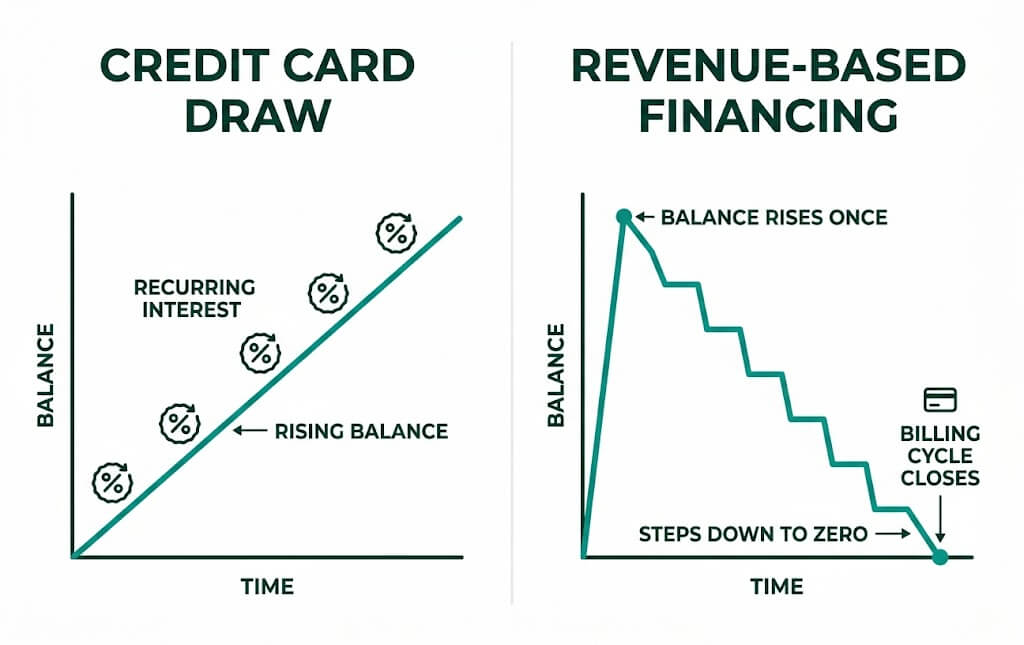
Some service business owners cover a billing gap by putting expenses on a personal or business credit card, treating the card’s grace period as a stopgap until client payments land. That approach works occasionally, but it comes with real trade-offs: card limits are usually sized for incidental expenses rather than a full payroll run, interest starts accruing quickly on any balance carried past the grace period, and a large draw can spike credit utilization in a way that hurts the business’s borrowing profile right when it needs it most. Revenue-based financing is sized to the actual gap, not a preset credit limit, and repayment is structured around the business’s revenue rather than a revolving interest rate that compounds the longer a balance sits unpaid.
For a consultancy or agency managing a recurring net-60 client base, the difference compounds over time. A business that repeatedly draws on a credit card to bridge payroll gaps can end up carrying a rotating balance that never fully clears, quietly eating into margin every month. A revenue-based advance sized to a specific billing cycle gets repaid as that cycle’s receivables come in, rather than becoming a permanent fixture on the balance sheet. The FTC’s guidance on business credit and financing is a useful reference for how interest and fees on revolving business credit accounts compound over time before deciding to rely on one for a recurring payroll gap.
Software and Contractor Costs Compound the Timing Problem
Payroll isn’t the only fixed cost working against a service business during a collections gap. Most agencies and consultancies run on a stack of monthly software subscriptions, project management tools, and specialized platforms that bill on their own schedule regardless of client payment timing. Add contractor and freelance costs, which many agencies use to flex capacity up during busy periods, and the fixed monthly outflow can rival or exceed payroll itself in some months.
This is part of why a service business’s cash flow problem often looks worse than its actual financial health would suggest. A consultancy carrying $15,000 in monthly software costs, $10,000 in contractor payments, and $40,000 in payroll has $65,000 in fixed monthly obligations that don’t care whether a client’s accounts payable department processed an invoice on time. When two or three clients slip their payment dates in the same month, even a modest delay can create a real cash shortfall against a business that’s fundamentally profitable and growing.
Get Your Service Business’s Working Capital in 24-48 Hours
Most agencies and consultancies complete the application in under 15 minutes. No collateral required. Your dedicated account manager reviews your application personally.
Start Your Application →Who Qualifies
Platform Funding requires a minimum of 6 months in business and $10,000 or more in average monthly revenue, evaluated primarily through recent business bank statements rather than a lengthy underwriting file built around collateral. This fits the way most agencies and consultancies actually operate: strong monthly deposit activity, healthy margins, and a client base that pays reliably, just not immediately. Over $2 billion has been funded to more than 30,000 businesses through this model, with an A+ Better Business Bureau rating and a 4.9 out of 5 Trustpilot score from 575 verified reviews.
A newer agency that’s only 8 or 9 months old but already billing consistently at $25,000 a month can qualify just as readily as a 10-year-old consultancy billing $200,000 a month, because the underwriting is anchored to recent revenue behavior rather than business age beyond the 6-month minimum. This matters for younger service businesses in particular, since they’re often the ones hit hardest by the net-30/60 gap while they’re still building the cash reserves that more established firms have had years to accumulate.
What This Type of Financing Is Typically Used For
Agencies and consultancies most commonly use this kind of financing to cover payroll during a billing gap after signing a new client, to fund a hiring push ahead of revenue materializing from a new contract, or to cover software and contractor costs during a slow collections month without pulling back on client-facing work. It’s rarely about a business in distress. It’s almost always a healthy business managing the mechanical reality of B2B billing cycles, which is a very different situation than what most lenders are built to underwrite. Some owners compare options like an installment structure against a revolving line before deciding which fits a specific billing gap best. A checklist of what to prepare before applying helps agencies move through the process without gathering the wrong documentation for their business type.
Repeat Timing Gaps Versus One-Time Crunches
Not every service business needs financing as a recurring tool. Some agencies hit a single collections crunch tied to one slow-paying client and never need to revisit financing once that account is resolved. Others operate structurally on 60 or 90-day terms with most of their client base, which means the timing gap isn’t a one-time event but a permanent feature of how the business is billed. Recognizing which situation applies matters for how a business should think about financing: a one-time gap calls for a single advance sized to bridge that specific shortfall, while a structural gap tied to standard client payment terms often calls for a standing relationship with a lender who understands the business’s billing cycle and can fund repeat advances without re-underwriting the relationship from scratch each time.
Agencies serving enterprise or government clients tend to fall firmly into the second category, since 60 to 90-day payment terms are often non-negotiable requirements set by the client’s own accounts payable policy rather than something the agency can push back on. For these businesses, treating financing as a recurring part of operating on those terms, rather than an emergency measure, tends to produce more predictable outcomes than waiting until a specific payroll date forces the issue.
Established agencies and consultancies with at least 6 months in business and $10,000 or more in monthly revenue who need $5,000 to $3,000,000 to cover payroll, software, or contractor costs while waiting on client invoices to clear.
Check Your Eligibility →How to Apply
The process starts with a short application and a review of recent business bank statements, with most qualifying businesses receiving a funding decision within 24 to 48 hours. There’s no requirement to itemize what the funds will be used for, and no client notification or invoice assignment involved at any point in the process. Service businesses can explore funding options directly to see what’s available based on their revenue history.

FAQ
Why does a profitable agency or consultancy run out of cash?
The most common cause is a timing mismatch between when the business bills clients and when payroll, software, and contractor costs are due. Net-30 or net-60 client payment terms mean revenue is earned and invoiced well before it’s actually collected, while operating expenses are due on a fixed monthly schedule regardless of the receivables timeline.
Is this different from a cash flow problem in retail or restaurant businesses?
Yes. Retail and restaurant cash flow issues are usually tied to seasonal demand or inventory costs. Agency and consultancy cash flow issues are almost always tied to B2B billing mechanics, specifically the gap between invoicing a client and actually receiving payment, which can be 30, 60, or 90 days depending on the client relationship.
Why do banks struggle to finance service businesses?
Traditional bank underwriting relies heavily on collateral, which most agencies and consultancies don’t have in a form banks recognize, since their core assets are client relationships and billable expertise rather than equipment or inventory. This often results in declines or low approval amounts despite the business having strong revenue and healthy margins.
How is revenue-based financing different from putting a payroll gap on a business credit card?
A credit card draw carries a revolving interest rate that keeps accruing until the balance is paid off, and card limits are typically sized for incidental expenses rather than a full payroll run. Revenue-based financing is sized to the actual billing gap and repaid as revenue comes in, rather than becoming an open-ended balance.
How much funding is typically available for a service business?
Platform Funding offers funding from $5,000 to $3,000,000, depending on the business’s monthly revenue and qualifications. Agencies and consultancies typically request an amount sized to cover one to two billing cycles of payroll and overhead during a specific growth or collections gap.
Do I need collateral or a certain credit score to qualify?
No collateral is required, and there’s no automatic credit score cutoff. Approval is based primarily on business revenue history and time in business, with a minimum of 6 months operating and $10,000 or more in average monthly revenue.
Will my clients know I’ve used this type of financing?
No. Revenue-based financing doesn’t involve client notification or any change to how clients are billed or who they pay. The financing relationship is entirely between the business and the lender.
Does growth make this cash flow problem better or worse?
Growth often makes it worse in the short term. A new client contract adds revenue on the books, but if that client pays on extended terms, the business often has to staff up and cover new overhead before the first payment arrives, widening the timing gap temporarily even as the business becomes more profitable overall.
What’s the fastest way to cover a payroll gap caused by slow client payments?
Revenue-based financing is typically funded within 24 to 48 hours for qualifying businesses, making it one of the faster options for covering an immediate payroll or overhead gap compared to a traditional bank line of credit, which can often take four to eight weeks or longer for approval.
Is this type of financing only for marketing agencies, or does it apply to other service businesses?
It applies broadly to any service business operating on delayed client payment terms, including consultancies, IT service firms, accounting and bookkeeping practices, and creative or production agencies. The underlying timing mismatch between billing and collection shows up across most B2B service industries.