


Platform Funding provides 24-48 hour funding decisions for established businesses with 12+ months’ operating history and $10,000+ monthly revenue. Revenue-based repayment automatically adjusts to your daily sales, reducing payments during slow periods without phone calls, modification requests, or default penalties. Access $10,000 to $500,000 with 95% approval rates when traditional banks say no.
Running an established business in mid-2026 means dealing with stretched payment cycles, cautious consumer spending, and bank lending that dried up. Your business still needs capital for payroll, inventory, and opportunities that won’t wait for perfect market conditions.
The businesses that survive uncertain markets versus those that struggle come down to one thing: flexible capital access when traditional options disappear. Platform Funding has funded over $2 billion to 30,000+ businesses specifically because revenue-based financing adjusts to business reality instead of forcing fixed payments during your worst months.
The Mid-2026 Cash Flow Reality
Consumer caution reshaped spending patterns across every industry. B2B payment terms that were 30 days in 2024 now stretch to 60 or 90 days. Inventory management became a daily balancing act. Labor costs keep climbing while margins compress.
Banks approve only 27% of small business loan applications. When they do approve, the process takes 4-8 weeks. For a supplier offering a 10% discount for payment this week or a competitor’s construction equipment going to auction Friday, eight weeks means you already lost the deal.
The businesses winning right now aren’t necessarily those with the most cash reserves. They’re the ones who built flexible financial systems that access capital in 48 hours and repay in ways aligned with revenue patterns.
Why Traditional Cash Flow Planning Doesn’t Work Anymore
Most cash flow advice assumes stable conditions. “Maintain three months’ reserves.” “Build 12-month projections.” This advice isn’t wrong. It’s incomplete for markets that change weekly.
When conditions shift rapidly, three-month reserves evaporate in six weeks. Twelve-month projections become outdated when suppliers change pricing or major customers delay payment. For businesses with a 12+ month operating history, adaptability beats predictability every time.
Revenue-based financing creates that adaptability. Access $10,000 to $500,000 in 24-48 hours with repayment adjusting to actual revenue. Revenue drops 20% one month? Capital repayment drops 20% automatically. Revenue bounces back? You pay down faster with no penalties.
This matters because fixed monthly payments don’t care about your reality. A $2,400 monthly loan payment happens whether you billed $28,000 or $63,000 that month. Revenue-based financing charges the same percentage regardless of performance level.
Building Your Cash Flow System in Three Layers
Effective cash flow planning requires thinking in layers, not single numbers sitting in your bank account.
Layer 1: Operating Reserve (Never Touch This)
Three months of baseline expenses that you never touch. For established businesses generating $10,000+ monthly revenue, this means $30,000 to $50,000 in accessible savings. Not invested in inventory. Not tied up in receivables. Reserved for actual emergencies like equipment failure or key employee departure.
Most businesses never build this reserve because they’re constantly reinvesting in growth. That works until it doesn’t. The first major disruption wipes out businesses operating paycheck to paycheck. Working capital management starts with this foundation, even if it takes 18 months to build.
Layer 2: Working Capital Access (Draw When You Need It)
Flexible capital you draw when opportunities or needs arise. Unlike traditional credit lines that charge interest whether you use them or not, you only pay for capital you actually draw. Unlike term loans with fixed payments regardless of business performance, working capital solutions adjust automatically.
A Dallas construction company drew $75,000 in March for material deposits on a large commercial project. June brought project completion and faster repayment. December brought a winter slowdown and automatic payment reduction. Same funding, same terms, automatic adjustment to revenue reality.
Layer 3: Strategic Growth Capital (Investment Money Only)
Money specifically for opportunities that expand your business or improve efficiency. Equipment that reduces costs by 30%. Technology that improves customer experience. Marketing spend during competitor weakness. New location in an underserved market.
Strategic capital comes from profits, dedicated funding rounds, or working capital reallocation when opportunity justifies it. The key distinction: this is investment money, not survival money. Restaurant financing for a second location isn’t the same as restaurant financing to cover this month’s payroll.
Why Revenue-Based Financing Works When Fixed Loans Don’t
Here’s the core difference between revenue-based financing and traditional business loans: capital costs automatically adjust to your business reality instead of a payment schedule created when conditions were different.
Bank loans charge identical monthly payments in your best and worst months. Credit cards charge interest regardless of your performance. Invoice factoring locks you into terms regardless of your collection cycles. Equipment financing works for machinery purchases but doesn’t help with working capital gaps.
Revenue-based financing adjusts to actual daily credit card sales and bank deposits. High-revenue week? You pay more (but you can afford it). Slow-revenue week? Automatic reduction with no modification requests, no missed payment fees, no defaulting because you can’t make a fixed payment during your worst quarter.
Real Business Example:
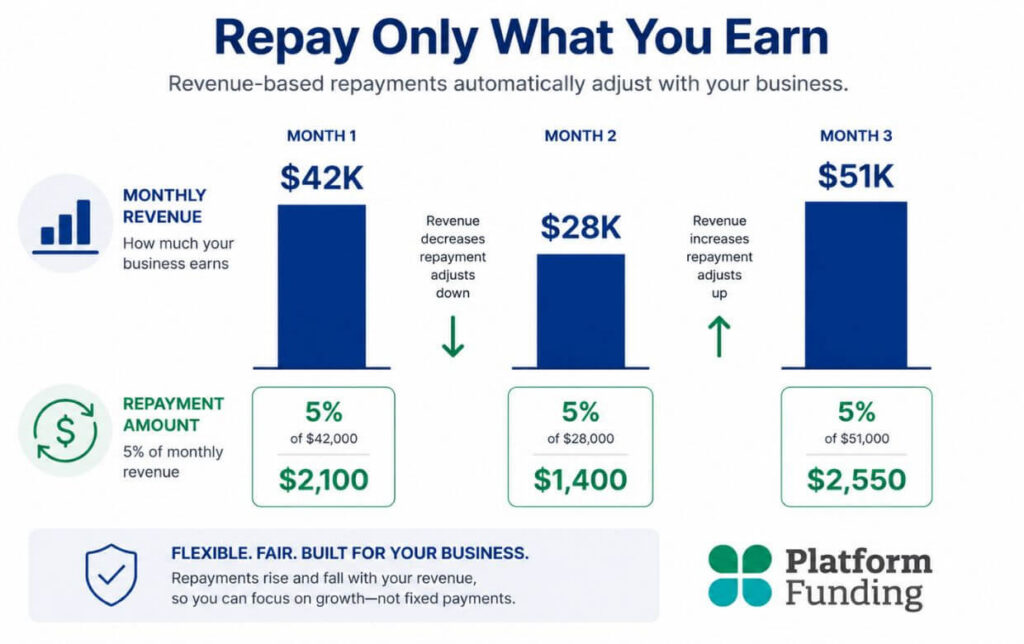
Chicago professional services firm took $85,000 in revenue-based financing in March 2026 for new office equipment and hiring two consultants:
- March: $42,000 revenue, $2,100 repayment (5%)
- April (client delays): $28,000 revenue, $1,400 repayment (5%)
- May (recovery): $51,000 revenue, $2,550 repayment (5%)
- June (strong quarter close): $63,000 revenue, $3,150 repayment (5%)
Same funding. Same terms. Automatic adjustment to business reality. When April brought unexpected client delays, no cash crunch from fixed payments that don’t care about your circumstances. When May and June recovered with project completions, there was faster paydown with no early repayment penalties.
Compare this to a traditional $85,000 loan at $2,400 monthly payment for 42 months. April’s $2,400 payment happens whether you’re billing $28,000 or $63,000. That difference between survival-friendly financing and cash-flow-killing debt: does your capital cost adjust to reality or ignore it completely?
This is why Platform Funding maintains a 95% approval rate for established businesses. We evaluate actual cash flow patterns and business performance, not just credit scores and collateral like traditional banks require.
Who Qualifies for Revenue-Based Financing
Revenue-based financing serves established businesses with a proven operating history: 12+ months in business, $10,000+ monthly revenue, and demonstrated cash flow patterns showing sustainable operations.
Why 12 Months Minimum Operating History?
Businesses under a year haven’t experienced full business cycles. They haven’t weathered slow seasons, faced unexpected operational challenges, or proven they can adapt when conditions change. Startups need investor capital and equity financing, not lender capital with repayment obligations. Lending to unproven businesses isn’t flexibility. It’s irresponsibility that hurts both the business and the lender.
Why a $10,000+ Monthly Revenue Threshold?
This threshold ensures sufficient cash flow to manage capital repayment during slower periods while maintaining normal operations. A business generating $8,000 one month and $3,000 the next month doesn’t have a financing problem. It has a business model problem that borrowing money won’t solve.
What About Credit Score Requirements?
Platform Funding doesn’t require perfect credit scores. Most approved businesses have credit scores between 600 and 720. What matters more: consistent business cash flow patterns and operating history. A 640 credit score attached to three years of consistent $25,000+ monthly revenue beats a 720 credit score attached to six months of inconsistent $15,000 monthly revenue.
This creates an interesting dynamic: established businesses often qualify for revenue-based financing when banks reject them outright. Banks underwrite based on credit scores, collateral, and rigid formulas created before you walked in. Alternative lenders like Platform Funding evaluate actual business performance and demonstrated cash flow patterns.
Smart Capital Uses vs. Dangerous Capital Uses
Not all capital needs justify borrowing during uncertain times. Let’s separate smart allocation from dangerous allocation that puts your business at risk.
Smart Capital Uses That Make Sense:
Survival Capital for Short-Term Timing Gaps
Covering payroll when a major customer delays payment 30 days beyond terms. Paying rent during a temporarily slow quarter while you’re securing new contracts. Managing essential inventory when supplier payment terms suddenly tighten. This defensive capital keeps your business operating when timing creates temporary gaps between cash outflows and inflows.
A Virginia distributor used $45,000 in revenue-based financing to cover payroll and rent in Q1 2026 when their largest client delayed payment 60 days due to their own cash flow issues. The funding maintained operations and kept their entire team intact. When the client eventually paid, the cash influx accelerated repayment. Total cost of capital: $6,200. Cost of losing their entire trained team and damaging their major client relationship: business-ending.
Opportunity Capital for Time-Sensitive Competitive Advantages
Buying distressed inventory from a competitor closing down at 40% below market rates. Acquiring specialized equipment from a business closure auction at 60% off retail. Capturing market share during competitor weakness by doubling down on marketing when others pull back. This offensive capital advances your competitive position when others are contracting.
Transportation and logistics companies used this strategy in early 2026 when fuel prices dropped suddenly. Those with immediate capital access bought six months of fuel contracts at depressed prices while competitors operated hand-to-mouth. The cost of capital was far less than the fuel savings locked in.
Efficiency Capital for Permanent Cost Reduction
Implementing technology that reduces manual processes by 40%. Upgrading equipment that cuts operational costs by 25%. Training programs that improve team productivity and reduce errors. This strategic capital improves your unit economics during both good times and bad times, making your business more resilient regardless of market conditions.
Dangerous Capital Uses That Increase Risk:
Speculative Expansion Without Proven Demand
Opening new locations when your existing locations aren’t optimized and profitable. Launching unproven products when your core products aren’t maximized. Geographic expansion based on optimistic projections rather than validated demand data. This is gambling, not investing.
Unproven Marketing or Technology Initiatives
Marketing channels you’ve never tested with real budget. Technology platforms without clear ROI calculations and payback timelines. Partnership opportunities based on hopeful projections rather than pilot results. Test small before betting big, especially with borrowed capital.
Luxury Upgrades That Don’t Move Business Metrics
Office renovations that don’t improve customer experience or employee efficiency. Premium equipment when standard equipment delivers 95% of the results. Expense category upgrades that signal success to yourself but don’t move revenue, margin, or customer satisfaction numbers.
The distinction matters because seasonal business financing for survival versus speculation creates completely different risk profiles. Platform Funding evaluates the purpose of capital as part of the underwriting process because we want businesses to succeed, not just approve applications.
Cash Flow Scenario Planning for Different Market Conditions
Effective planning requires thinking through multiple scenarios, not just your most likely projection.
Baseline Scenario: Current Trajectory Continues
Revenue stays within 15% of your 12-month average. Major customers remain stable and pay on normal terms. Supplier pricing and terms stay relatively consistent. Your planning should handle this baseline scenario without constantly accessing external capital beyond normal operating cycles.
If your baseline scenario requires constant capital injection just to maintain current operations, you have a profitability problem, not a financing problem. Fix your unit economics and business model before borrowing money. Capital amplifies what’s already working. It rarely fixes what’s fundamentally broken.
Downside Scenario: Revenue Drops 20% to 30%
A major customer churns to a competitor. Market demand weakens across your industry. Competitor pricing pressure forces margin compression. Economic headwinds reduce discretionary spending in your category. Your planning should account for accessing working capital to bridge the gap while you adjust operations and expenses.
This scenario is where flexible capital access becomes crucial. Can you quickly access $50,000 to cover a two-month revenue gap while you’re reducing expenses and pivoting strategy? Do you have lending relationships established before you desperately need them?
Upside Scenario: Revenue Grows 30% to 50% Faster Than Expected
Unexpected large contract wins. Seasonal surge that exceeds your highest projections. Competitor exit creates sudden market share opportunity. Viral marketing success or product-market fit breakthrough. Your planning should account for the capital intensity of rapid growth.
Growth is expensive. You need more inventory before you’ve collected revenue from existing sales. You need additional staff before the new revenue fully materializes. You need larger facility space and equipment before growth pays for itself. Businesses that stumble during rapid growth aren’t poorly managed. They’re under-capitalized for the expansion speed.
Retail business financing during unexpected growth spurts often determines which businesses capture market share permanently versus which businesses lose the opportunity because they couldn’t scale fast enough.
Crisis Scenario: Major Operational Disruption
A key supplier suddenly goes out of business. Catastrophic equipment breakdown that halts production. Critical team member departure during your busiest season. Unexpected regulatory change requiring immediate compliance investment. Natural disaster or facility damage requiring urgent repairs.
Your planning should include a crisis response protocol: which expenses you cut immediately, which capital sources you access urgently, which customers you might ask for advance payment, and which operations you can temporarily outsource.
Most businesses don’t fail from slow decline over years. They fail from sudden shocks they weren’t positioned to absorb financially or operationally. Having $100,000 in emergency capital access available within 24-48 hours often means the difference between weathering the storm and permanently closing your doors.
Building Capital Relationships Before You Urgently Need Them
Smart businesses don’t rely on a single capital source for all situations. They build capital stacks that provide options based on specific needs and circumstances.
Bank Line of Credit (If You Qualify for Traditional Banking)
Lowest cost option for businesses with strong credit profiles. Best used for short-term working capital needs with clear repayment paths. Typically requires 2-3 years in business, credit scores above 720, and significant collateral. Many businesses maintain bank credit lines even if they rarely use them because it’s cheap insurance for predictable needs.
Revenue-Based Financing (Platform Funding’s Specialty)
Middle-ground option offering speed (24-48 hours), flexibility (repayment adjusts to revenue), and lower qualification barriers (12+ months operating, $10,000+ monthly revenue). Works for businesses that don’t qualify for traditional bank lending or need faster access than banks provide. Platform Funding specializes in this exact category.
Equipment Financing for Major Purchases
Dedicated capital for equipment purchases where the equipment itself serves as collateral. Often secures better rates than unsecured financing because the lender has collateral security. Preserves your working capital for operations rather than tying up large chunks of cash in equipment purchases. Best for construction financing of heavy equipment and machinery.
Customer Advance Payment for Large Projects
Negotiating advance payment from customers for large B2B projects. Zero-cost capital, though you may need to offer slight pricing discounts to secure advances. Works best for project-based businesses with large contracts and established customer relationships.
The strategy: build these relationships before you urgently need them. Applying for credit during a cash crisis signals desperation and reduces approval odds. Applying during stable periods signals professional cash flow management and improves terms. The same principle applies to revenue-based financing. Establish the relationship when you’re not urgently desperate, then access capital quickly when opportunity or necessity arises.

The Platform Funding Approach to Business Capital
Platform Funding structures revenue-based financing specifically for established businesses operating in uncertain market conditions. Our model reflects a simple principle: capital costs should match your business reality, not rigid payment schedules decided when economic conditions were completely different.
What Makes Platform Funding Different:
Speed Over Bureaucratic Process: Application to funding in 24-48 hours, not the 4-8 weeks traditional banks require. When a supplier offers a 15% discount for payment this week, or competitor equipment goes to auction Friday, waiting six weeks means you’ve already lost the opportunity. Speed matters when opportunities have expiration dates.
Flexibility Over Fixed Payment Schedules: Repayment adjusts to your revenue automatically. February generates $35,000 in revenue; you repay $1,750 (5%). July generates $62,000 in revenue; you repay $3,100 (5%). Same funding agreement. Same percentage terms. Automatic adjustment to business performance without phone calls or modification requests.
Revenue History Over Credit Scores Alone: A 640 credit score with three years of consistent $30,000+ monthly revenue typically qualifies. A 750 credit score with only six months of inconsistent $15,000 monthly revenue typically doesn’t. We evaluate business cash flow patterns more heavily than personal credit history because business performance predicts repayment capacity better than FICO scores.
Multiple Funding Rounds Over One-Time Events: Once you’ve successfully repaid your first funding round, accessing additional capital in the future typically requires minimal documentation. Your proven repayment history becomes your primary qualification. Many Platform Funding clients use revenue-based financing multiple times per year as operational needs and growth opportunities arise. We’re building relationships, not processing one-time transactions.
This model particularly serves businesses operating in the gap between traditional banking requirements and desperate emergency funding situations. You’re established enough that you have consistent revenue and a real operating history but are not established enough to meet rigid bank requirements for pristine credit, multi-year track records, and substantial collateral.
Platform Funding has provided over $2 billion in funding to 30,000+ businesses across multiple economic cycles. We understand that established businesses need flexible capital that works with their reality, not against it.
Frequently Asked Questions About Cash Flow Planning and Business Financing
Can newly launched businesses access working capital during economic downturns?
No. Revenue-based financing serves established businesses with a 12+ month operating history and $10,000+ monthly revenue. Startups and new businesses need equity investors and founder capital, not lender capital with repayment obligations. Lending to unproven businesses isn’t flexibility. It’s irresponsible lending that hurts both the business and the lender when cash flow can’t support repayment.
What if my revenue is down 20% from last year but still consistently above $10,000 monthly?
You can still qualify for revenue-based financing. Lenders evaluate cash flow consistency and patterns, not whether your revenue is increasing year-over-year. A business generating a consistent $15,000 monthly (even if previously $19,000 last year) demonstrates more stable repayment capacity than a business with highly variable revenue swinging from $5,000 to $30,000 monthly. Consistency matters more than growth trajectory for lending decisions.
How do automatic repayment adjustments actually work in practice?
Revenue-based financing repays through a percentage of daily credit card sales plus scheduled ACH deductions from your business bank account. High-revenue day? Larger repayment that day. Low-revenue day? Smaller repayment that day. The percentage stays constant (typically 5% to 15% depending on terms), but the actual dollar amount fluctuates automatically with your daily performance. No phone calls required. No modification requests. No risk of defaulting from slow periods.
Can I access capital when I’m in survival mode rather than growth mode?
Yes. Capital doesn’t only fund growth initiatives. It also bridges timing gaps, manages cash flow mismatches, and maintains operations during temporary challenges. A seasonal business using capital to cover winter operating expenses while waiting for spring revenue isn’t speculation. It’s practical cash flow management. The key qualification: your business fundamentals need to be viable and worth preserving, not a failing operation where borrowing only delays the inevitable.
What if banks rejected my application due to general economic concerns about my industry?
Alternative lenders like Platform Funding evaluate applications differently than traditional banks. Banks often implement industry-wide lending policies like “not lending to restaurants right now” or “reducing retail exposure across all applications.” Alternative lenders evaluate individual businesses within those industries. Does this specific restaurant have consistent cash flow? Does this particular retail business have proven operating history and viable unit economics? Your business might succeed despite broader industry headwinds.
How quickly can I actually access capital during urgent situations?
Platform Funding’s typical timeline: initial application submission takes 15 minutes online. Preliminary review happens within 2-4 hours during business hours. Approval decision and terms provided within 24-48 hours. Funding is deposited to your business bank account within 24-48 hours after you accept terms. Total timeline from application to funds available: 48 to 96 hours in most cases. Compare this to traditional banks requiring 4-8 weeks minimum for business loan processing.
Do I risk defaulting if business conditions worsen after I receive funding?
Revenue-based financing substantially reduces default risk compared to fixed-payment loans because repayment automatically adjusts to your revenue performance. If your revenue declines 40% due to market conditions, your repayment obligation automatically declines 40% as well. The funding stays current, you maintain adequate operating cash flow, and you avoid the missed payment spiral and default fees that destroy businesses using traditional fixed-payment loans during downturns.
Can I access multiple types of working capital financing simultaneously from different sources?
Yes. Many businesses maintain bank credit lines (lowest-cost short-term option), revenue-based financing (flexible working capital), equipment financing (machinery and vehicle purchases), and customer advance payment arrangements (large project funding). Different capital sources serve different purposes in your financial stack. The key requirement: managing all obligations responsibly and ensuring your cash flow supports all repayment commitments simultaneously.
Taking Action on Your Business Cash Flow Strategy
Effective cash flow planning isn’t about perfection. It’s about preparation. The businesses successfully navigating market uncertainty aren’t necessarily those with the most cash reserves or the most accurate future predictions. They’re the businesses that know their numbers, plan for multiple scenarios, and maintain capital access relationships before they urgently need them.
Platform Funding has provided over $2 billion in funding to 30,000+ businesses across multiple economic cycles and market conditions. The businesses using capital most effectively aren’t necessarily facing the biggest challenges or experiencing the fastest growth. They’re the businesses accessing capital strategically, repaying responsibly, and maintaining ongoing relationships for future needs as they arise.
If your business has a 12+ month operating history and generates $10,000+ monthly revenue, you likely qualify for flexible capital access with 24-48 hour funding decisions and revenue-based repayment that adjusts to your performance. Whether you need funding today or you’re simply establishing a relationship for future use, the initial conversation costs nothing and creates no obligation.
Apply for funding now or call (866) 473-1455 to speak with a Platform Funding business capital specialist about your specific situation and qualification.
Or call (866) 473-1455 to speak with a business capital specialist · 15-minute application · No obligation
Related Resources for Business Owners:
- What Is Revenue-Based Financing? Complete 2026 Guide
- Business Lines of Credit: How They Work
- Working Capital Loans for Established Businesses
- Fast Business Funding: 24-48 Hour Decisions
- Seasonal Business Cash Flow Management
- Construction Industry Financing Options
- Restaurant and Hospitality Business Funding
- Retail Business Working Capital Solutions
- Transportation and Logistics Financing
- Equipment Financing for Business Growth
- Alternative Business Funding Options Compared
- Covering Payroll Gaps with Working Capital