


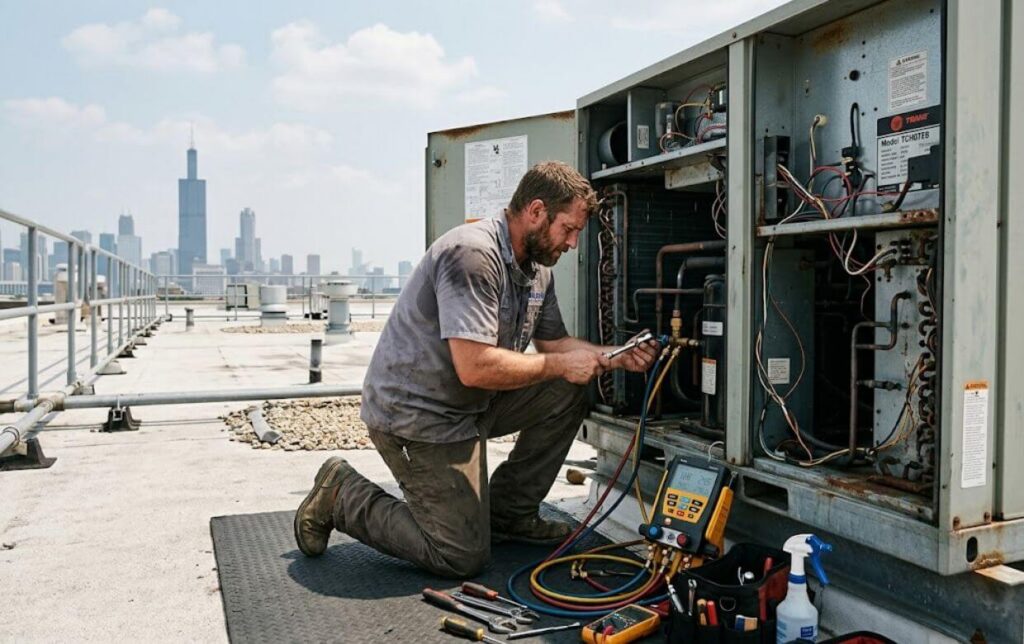
HVAC contractor financing is revenue-based financing that gives heating and cooling businesses fast access to working capital for seasonal staffing, parts inventory, service vans, and emergency repair costs that arrive faster than payment from customers does. Platform Funding provides this financing in amounts from $5,000 to $3,000,000, with funding decisions in 24 to 48 hours and a 95 percent approval rate among qualifying applicants, so HVAC contractors don’t have to turn down jobs or delay payroll during the months that matter most.
HVAC sits alongside the other trades under Platform Funding’s construction industry financing umbrella, and it deals with one of the sharpest seasonal demand swings of any of them. Demand for cooling repairs climbs sharply heading into summer, and heating demand spikes again in the fall as the weather turns. AC repair search activity and service call volume rise noticeably each year as temperatures climb, and emergency heating repair calls follow the same pattern in reverse, spiking well above off-season levels once cold weather sets in. A contractor running at reduced capacity in the slower months can suddenly find themselves at or near full capacity from May through September, and that swing changes what the business needs financially almost overnight.
Why HVAC Cash Flow Gets Squeezed Exactly When Business Is Good
The busiest season should be the most profitable, and eventually it is. But the timing of expenses versus revenue doesn’t cooperate during the ramp-up. A contractor heading into peak cooling season often needs to bring on seasonal technicians, stock up on the parts most likely to be needed for common repairs, and sometimes add a service van or two to handle call volume, all before a single dollar from that season’s work has come in. This is the same squeeze covered in Platform Funding’s broader cash flow solutions for seasonal businesses, just playing out on an HVAC contractor’s specific calendar.
Specialty trade contractors, including HVAC, electrical, and plumbing businesses, widely report ongoing skilled labor shortages that make it difficult to staff up quickly once peak season hits, a challenge that tends to run even tighter than the labor shortages facing general construction. That makes seasonal hiring harder and more expensive than it might otherwise be, and it often means a contractor has to move on a hiring opportunity the moment it appears rather than waiting for the next payroll cycle to free up cash.
What HVAC Contractor Financing Actually Covers
The capital itself isn’t earmarked for one specific use. It’s working capital a contractor can apply wherever the business needs it most that week, and in practice, a few categories show up consistently.
Seasonal staffing costs are usually the first pressure point. Bringing on technicians ahead of the summer or fall rush means payroll obligations start before the season’s revenue does, and contractors who wait until cash flow catches up often miss the best hiring window entirely. This is the exact gap working capital loans that cover payroll are built to close. Parts and inventory follow a similar pattern: stocking common repair parts, refrigerant, and replacement components ahead of demand means paying suppliers before the jobs that will use that inventory are even booked, which is one of the scenarios covered in these equipment and inventory purchasing strategies.
Service vans and equipment are a less frequent but higher-dollar need. A contractor adding a second or third crew for the season typically needs a vehicle to put that crew on the road, and vehicle financing or a down payment often competes directly with the same cash a contractor needs for payroll and parts in the same stretch of weeks, a tradeoff explored further in this look at financing fleet upgrades without taking on new debt. Emergency repair costs round out the list, since a contractor fielding a high volume of urgent calls during a heat wave or cold snap needs parts and labor capacity available immediately, regardless of how quickly the customer pays the invoice. The cost of that kind of unplanned downtime is covered in more detail in the true cost of equipment downtime.
A Real-World Scenario
Consider an HVAC contractor in Dallas heading into a July heat wave with call volume up sharply over the prior month. The business had two technicians on staff, more urgent calls coming in daily than they could handle, and a clear opportunity to bring on a third technician immediately, but payroll for the existing team plus a parts order for common compressor and capacitor replacements had already stretched the business’s cash position thin.
Rather than turning away calls or delaying the new hire until the next invoice cycle cleared, the contractor applied for revenue-based financing on a Tuesday and had $40,000 in the business account by Thursday. The funds covered the new technician’s first month of payroll, a parts restock, and a deposit on a used service van. Repayment was structured as a percentage of the business’s daily revenue, which meant payments scaled up during the remaining weeks of peak season and tapered off naturally once the heat wave passed and call volume normalized.
Peak season is here
Get your seasonal capital in 24–48 hours
Most HVAC contractors complete their application in under 15 minutes. No collateral required. Your dedicated account manager reviews your application personally.
Start Your Application →How Qualification Works for HVAC Contractors
Platform Funding’s qualification standards are built for businesses that already have an operating history, not contractors just starting out, which is consistent with how Platform Funding evaluates business loan applicants across every industry it serves. To qualify, an HVAC business generally needs at least 6 months in operation and $10,000 or more in average monthly revenue. Underwriting also reviews business and personal credit history along with several months of bank statements, a process outlined step by step on Platform Funding’s how it works page, though it’s designed to move considerably faster than a conventional bank loan application.
This isn’t a guaranteed approval, and Platform Funding doesn’t market it that way. Roughly 95 percent of qualifying applicants receive a funding decision, which is meaningfully higher than an average approval rate of around 27 percent at traditional banks for small business loans. That approval gap tends to be widest in trades and industries that traditional banks underwrite more conservatively, HVAC included, where seasonal revenue patterns can look riskier to a bank than they actually are.
Revenue-Based Financing Versus Equipment Financing for HVAC
Contractors sometimes assume equipment financing is the right tool for every HVAC-related capital need, but the two products serve different purposes. Equipment financing is typically tied to a specific purchase, such as a service van or a piece of diagnostic equipment, and the asset itself often serves as collateral. That structure works well when the need is a single, identifiable purchase with a clear price tag, and it can come with a lower cost of capital than an unsecured product when the contractor qualifies and has time to wait through the underwriting process. This comparison of equipment leasing versus a business loan breaks down that tradeoff in more depth for contractors weighing a single large purchase.
Revenue-based financing doesn’t require a specific purchase to justify the funding. It’s underwritten against the business’s overall revenue, which makes it a better fit for the kind of blended need most seasonal HVAC contractors actually have: some payroll, some parts, maybe a van down payment, all at once, none of which maps cleanly to a single invoice or equipment purchase. A contractor managing a seasonal ramp-up rarely has just one need; they have several smaller ones stacked together, and revenue-based financing covers that mix without requiring a separate application for each piece.
There’s also a timing consideration that matters more for HVAC contractors than it might for other businesses. Equipment financing underwriting often takes longer because the lender has to evaluate the specific asset being financed, sometimes including an appraisal or vehicle inspection. A contractor who recognizes a staffing or parts opportunity mid-surge, with call volume already climbing, usually doesn’t have the runway to wait through that process. Revenue-based financing’s faster underwriting timeline is built for exactly that kind of situation, where the cost of moving slowly, in missed calls and lost revenue, outweighs the savings from a lower-cost but slower product.
95%
Funding decision rate vs 27% at banks
24–48h
Typical time from application to capital
$2B+
Total capital funded to businesses
30,000+
Businesses funded nationwide
Why Repayment That Flexes Matters More in a Seasonal Trade
HVAC revenue is naturally uneven across the year, which makes fixed-payment debt, including a standard line of credit with a flat monthly draw, a particularly poor fit compared to other types of businesses with steadier income. A contractor might generate the bulk of a year’s revenue across five or six months, with the remaining months bringing in routine maintenance work and far less emergency call volume.
Because revenue-based repayment is calculated as a percentage of actual daily revenue rather than a fixed monthly amount, the payment naturally scales up during the high-revenue months and tapers during the slower ones. That structure removes a real source of stress that fixed-payment products create for seasonal businesses: a flat payment due in February looks very different against July’s revenue than it does against February’s, and the broader seasonal business financing strategies Platform Funding recommendations are built around that same difference rather than ignoring it.
What Separates a Seasonal Staffing Gap From a Deeper Cash Flow Problem
It’s worth distinguishing between the timing gap this article addresses and a more fundamental revenue shortfall. A contractor who genuinely doesn’t have enough booked work to sustain the business, even during what should be peak season, is dealing with a different problem than a timing mismatch, and financing won’t fix a demand problem. The U.S. Small Business Administration’s guidance on managing business finances points to this same distinction: financing should bridge a gap between confirmed revenue and current cash position, not substitute for revenue that doesn’t exist.
The gap this type of financing addresses is the lag between when a contractor needs to spend, on staffing, parts, or a vehicle, and when the season’s revenue actually lands in the business account. It’s closely related to the timing problem covered in this breakdown of the real cost of delayed receivables, and it’s also why some contractors compare revenue-based financing against short-term bridge financing when deciding how to cover the gap. Either way, it’s a timing problem with a clear resolution once the season’s work comes in, which is part of why it’s a reasonable use of short-term, higher-cost capital rather than something to view with the same caution as taking on long-term debt for a structural shortfall.
How Geography Changes the Seasonal Pattern
The dual-peak pattern described above isn’t identical everywhere. A contractor in Phoenix or Houston deals with a much longer, more intense cooling season than a contractor in Minneapolis or Buffalo, where the heating season carries more of the year’s revenue and the cooling season is shorter and less extreme. A contractor in a region with genuine four-season weather, like much of the Mid-Atlantic or Midwest, often sees two real peaks of roughly comparable intensity, while a contractor in the Sun Belt might see one dominant cooling peak and a much smaller heating bump.
This matters for financing timing because the staffing and parts decisions that create the cash flow gap need to happen ahead of whichever peak is dominant in a given market. A Phoenix contractor planning for summer needs to have technicians and inventory in place by April or May, while a Minneapolis contractor’s bigger planning window is more likely to fall in late summer ahead of the heating season. Contractors operating across multiple climate zones, or who’ve recently expanded into a new market with a different seasonal pattern than what they’re used to, sometimes underestimate how much earlier they need to start the staffing and inventory buildup relative to what worked in their previous market.
Financing a Seasonal Ramp Versus Saving for It
Some HVAC contractors try to solve the seasonal cash crunch by building up a cash reserve during slower months specifically earmarked for the next season’s ramp-up. That’s a reasonable strategy when it works, but it has a real limitation: it requires the slower months to actually generate enough surplus to fund the next peak, and a slower-than-usual off-season, an unexpected repair bill, or a delayed customer payment can quietly drain that reserve before the season even starts.
Financing doesn’t replace the discipline of building reserves, but it does remove the single point of failure that comes with relying entirely on saved-up cash. A contractor who’s built a reserve and still has access to revenue-based financing has two ways to handle a seasonal ramp instead of one, and that second option matters most in exactly the years when the reserve didn’t build up the way it was supposed to.
Residential Versus Commercial HVAC Cash Flow Patterns
Not every HVAC contractor experiences the seasonal squeeze the same way, and the residential versus commercial split matters here. Residential HVAC work tends to track closely with the seasonal patterns described throughout this article, since homeowners call when their system fails or when seasonal maintenance comes due, and that demand genuinely concentrates around weather extremes. A residential-focused contractor’s cash flow gap is almost entirely a function of when the season hits.
Commercial HVAC work often runs on a different timeline. Office buildings, retail spaces, and industrial facilities frequently schedule major system replacements and large maintenance contracts based on budget cycles or lease terms rather than weather, which can smooth out some of the seasonal swing but introduce a different kind of lump-sum timing problem. A contractor with a mixed residential and commercial book of business sometimes deals with both patterns simultaneously: a seasonal staffing surge driven by residential emergency calls layered on top of a large commercial contract with payment terms that don’t line up with either.
For contractors in this mixed position, operating working capital flexibility matters even more, since there isn’t one clean seasonal pattern to plan around. Revenue-based financing’s lack of a specific use requirement is particularly useful here, because the same funding round can cover residential seasonal staffing and a gap created by a commercial client’s net-60 payment terms without needing to treat them as separate financing problems.
What Documentation to Have Ready
Contractors who move fastest through the application process generally have three to six months of business bank statements ready, since underwriting relies on actual deposit history rather than seasonal projections. Basic information about how long the business has been operating and average monthly revenue rounds out what’s needed to get started, and Platform Funding’s loan application preparation checklist walks through the full list. None of this requires the extensive packaging a bank loan application typically demands; the goal is speed and accuracy rather than a polished presentation.
Platform Funding has funded more than $2 billion to over 30,000 businesses, holds an A+ rating with the Better Business Bureau, and maintains a 4.9 out of 5 rating on Trustpilot based on 575 verified reviews, a track record detailed further on Platform Funding’s testimonials page and in this broader look at how Platform Funding compares to other alternative business lenders. For an HVAC contractor weighing whether to trust a lender with a time-sensitive seasonal need, that track record is worth considering alongside the speed of the funding decision itself. The Federal Trade Commission also publishes general guidance for small businesses evaluating lenders, which is a useful independent reference for any contractor comparing financing options for the first time.

Planning Ahead of the Season Instead of Reacting to It
Contractors who’ve run an HVAC business through a few seasonal cycles tend to recognize the pattern: the same staffing and parts pressure shows up every year around the same time, even if the exact timing shifts a few weeks based on weather. Having financing access lined up before the season ramps, rather than scrambling once call volume spikes, tends to be the difference between capturing the extra revenue a busy season offers and watching some of it go to a competitor who could staff up faster, a dynamic also covered in this look at how working capital helps businesses scale operations faster.
Contractors ready to see what they qualify for can start an application through Platform Funding ahead of the next seasonal surge, rather than waiting until call volume is already climbing. For answers to additional questions beyond what’s covered below, Platform Funding’s full FAQ page covers qualification, repayment, and the application process in more detail.
Ready to apply?
Talk to a dedicated account manager about your funding needs
No pressure, no countdown. Your account manager can give you a clear picture of what’s available before you formally apply.
Frequently Asked Questions
What is HVAC contractor financing?
HVAC contractor financing is revenue-based funding that gives heating and cooling businesses fast access to working capital for seasonal staffing, parts inventory, service vans, and emergency repair costs. It’s not tied to a single purchase or invoice; it’s capital tied to the business’s overall revenue, which makes it usable for whatever combination of seasonal needs comes up at once.
How is this different from equipment financing?
Equipment financing is typically tied to a specific purchase, like a service van, with the equipment itself often serving as collateral. HVAC contractor financing through a revenue-based model isn’t tied to one purchase; it’s underwritten against the business’s overall revenue, which makes it a better fit when a contractor has several smaller needs, like payroll, parts, and a vehicle down payment, all coming up around the same time.
How much can an HVAC contractor borrow?
Platform Funding offers revenue-based financing from $5,000 to $3,000,000. The specific amount a contractor qualifies for depends on monthly revenue, time in business, and overall financial history, evaluated during the application process.
What are the qualification requirements?
Generally, an HVAC business needs at least 6 months in operation and $10,000 or more in average monthly revenue to qualify. Underwriting also reviews business and personal credit and recent bank statements, though the process is built to move faster than traditional bank underwriting.
How quickly can an HVAC contractor get funded?
Platform Funding targets a funding decision within 24 to 48 hours of a completed application. Contractors who need to move quickly on a seasonal hire or an unexpected parts order are typically able to go from application to funded within that window.
Can this be used for both staffing and equipment needs at the same time?
Yes. Because the financing is tied to the contractor’s overall business revenue rather than a single purchase, it can be applied across whatever combination of needs the business has, including payroll, parts inventory, and a vehicle down payment within the same funding round.
Does revenue-based financing make sense for a business with such uneven seasonal revenue?
It’s actually a better fit for seasonal businesses than fixed-payment debt, since repayment is calculated as a percentage of actual daily revenue rather than a flat monthly amount. Payments scale up during peak months and taper during slower months, which lines up with how HVAC revenue naturally moves through the year.
What happens if call volume drops off faster than expected after peak season ends?
Repayment adjusts automatically with revenue, so if call volume slows down sooner than anticipated, the payment amount slows down with it. This is one of the core differences from a fixed-payment loan, which doesn’t account for a business’s actual revenue pattern from month to month.
Is this only useful during peak cooling or heating season, or can it be used year-round?
While seasonal staffing and parts needs are the most common use case described here, the same financing product is available year-round for any working capital need that meets the qualification requirements, including slower-season cash flow gaps or unexpected emergency repair surges outside the typical peak months.
How does Platform Funding compare to other lenders for HVAC contractors?
Platform Funding offers a 95 percent approval rate among qualifying applicants, funding amounts up to $3,000,000, an A+ Better Business Bureau rating, a 4.9 out of 5 Trustpilot rating from 575 verified reviews, and a dedicated account manager assigned from application through repayment, supported by more than $2 billion funded to over 30,000 businesses.