

Who This Is For
Established plumbing contractors with at least 6 months in business and $10,000 or more in monthly revenue who need $5,000 to $3,000,000 to cover service van costs, commercial materials, or crew payroll while waiting on a commercial contract to pay.
Plumbing contractor financing is revenue-based funding that gives plumbing businesses fast access to working capital for service van upgrades, equipment and parts inventory, and the payment gap that opens up when a business moves from residential service calls into larger commercial contracts. Platform Funding provides this financing in amounts from $5,000 to $3,000,000, with funding decisions in 24 to 48 hours, so plumbing contractors don’t have to slow down growth because commercial clients pay on a different timeline than residential ones do.
Residential plumbing work tends to pay quickly, often within days, especially when a contractor collects on-site or offers digital payment options. Commercial plumbing work runs on a completely different clock. Many plumbing contractors wait 60 to 90 days or longer to collect on completed commercial work, while payroll, fuel, parts, and service van payments keep coming due every week regardless of where a given invoice sits in someone else’s approval process. That shift in payment timing is one of the more common reasons a growing plumbing business runs into real cash flow strain from delayed receivables right as it’s winning bigger, better work.
95%
Funding decision rate vs 27% at banks
24-48h
Typical time from application to capital
$2B+
Total capital funded to businesses
30,000+
Businesses funded nationwide
Why Moving Into Commercial Work Changes the Cash Flow Math
A plumbing business built around residential service calls develops a rhythm: a job gets done, the customer pays that day or within a couple of weeks, and the cash cycle resets quickly. Commercial work, particularly larger contracts involving general contractors and progress billing, doesn’t work that way. Payment is often tied to milestones, requires a formal pay application, and frequently includes retainage, typically 5 to 10 percent of the contract value, held back until the project reaches substantial completion.
That means a plumbing contractor taking on a commercial rough-in or a larger renovation contract is effectively financing the project’s labor and materials out of pocket for weeks or months before seeing payment, on top of whatever residential work the business continues to handle on its normal, faster-paying schedule. Plumbing is closely connected to the broader construction financing landscape, and the cash flow patterns and payment structures are nearly identical to what general contractors navigate on larger jobs. Materials alone can represent thousands of dollars in upfront cost on a single commercial job, paid to suppliers well before the general contractor pays the plumbing sub.
What Plumbing Contractor Financing Actually Covers
The capital isn’t tied to a single use; it’s working capital a contractor can apply to whatever the business needs most as it manages this mix of residential and commercial cash flow timing. A few categories come up most consistently.
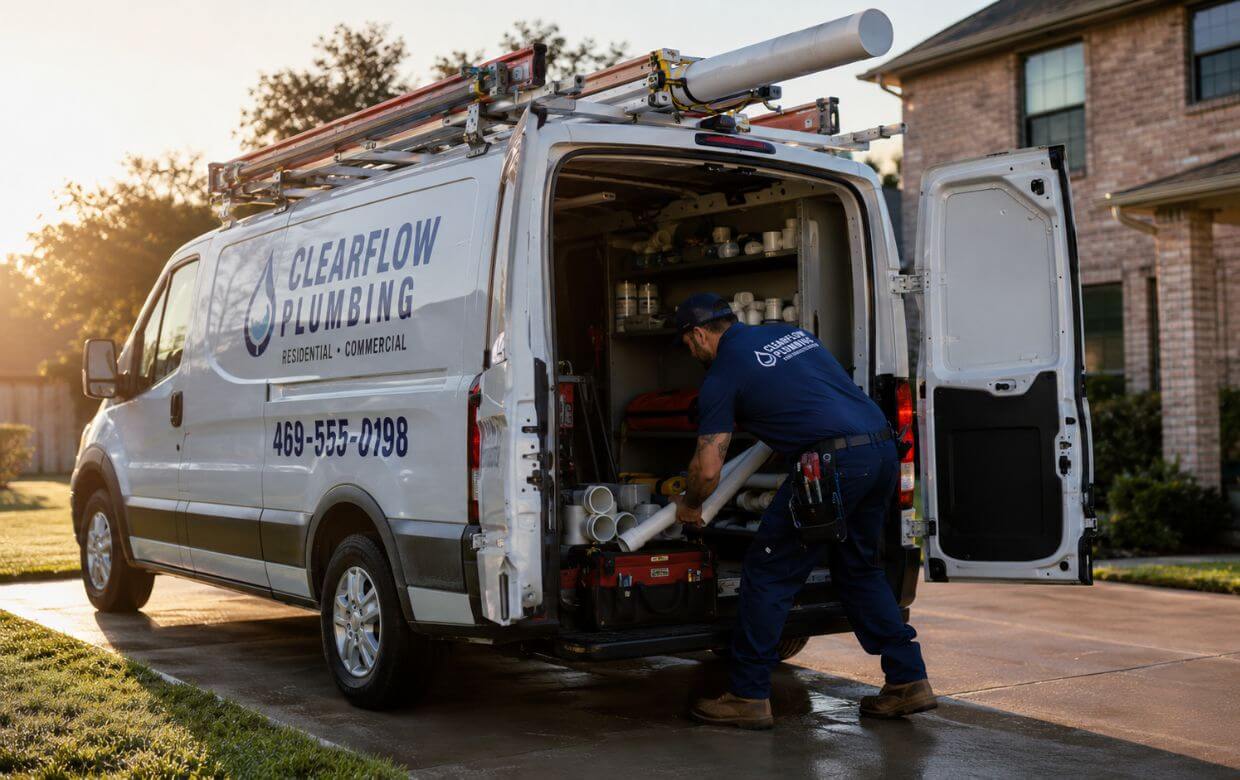
Service van upgrades and additions are a frequent need, since a growing plumbing business often needs to add a vehicle to handle increased call volume or to staff a new crew for a commercial contract. Keeping those vehicle costs from straining cash flow is something contractors across multiple trades manage with working capital rather than a dedicated vehicle loan. Parts and equipment inventory follow closely, particularly jetters, specialized tools, and the kind of stocked parts inventory that lets a crew respond to calls without waiting on a supplier order; contractors who have thought through smart purchasing strategies for equipment know that delays here ripple through job scheduling quickly. Covering payroll gaps when a commercial payment is still in transit is the third major category, since crew wages don’t pause just because a pay application is sitting in a general contractor’s approval queue. Materials deposits for larger commercial jobs round out the list, especially for water heaters, sewer line materials, and other higher-cost items that need to be purchased well ahead of installation.
A Real-World Scenario
Consider a plumbing contractor in Charlotte who built the business on residential service calls and recently won a $380,000 commercial rough-in contract for a new retail development. The general contractor’s payment terms were structured at net-60 with 10 percent retainage held until project completion. The plumbing contractor needed to add a second service van to keep up with residential call volume while dedicating an existing crew to the commercial job, and materials for the rough-in, primarily piping and fixtures, needed to be ordered and paid for almost immediately to stay on the general contractor’s schedule.
Rather than pulling cash from the residential side of the business or delaying the materials order and risking the project timeline, the contractor applied for revenue-based financing through Platform Funding and had $58,000 in the business account within two days. The funds covered a down payment on the new service van, the materials order, and two weeks of payroll for the crew assigned to the commercial job. Repayment was structured as a percentage of the business’s overall revenue, residential and commercial combined, which meant the payment scaled naturally as both sides of the business generated income on their own separate timelines.

How Qualification Works for Plumbing Contractors
Platform Funding’s qualification standards are built for businesses with an established operating history, not contractors just starting out. To qualify, a plumbing business generally needs at least 6 months in operation and $10,000 or more in average monthly revenue. Underwriting reviews business and personal credit history along with recent bank statements, though the process moves considerably faster than a traditional business loan application.
Platform Funding doesn’t promise approval to everyone who applies. Roughly 95 percent of qualifying applicants do receive a funding decision, a rate well above the roughly 27 percent average approval rate traditional banks extend to small businesses for loans. Research on which industries get approved for business financing fastest helps put that comparison in context. This matters most when a contractor needs to move quickly on a materials order or a payroll gap tied to a specific project deadline.
Most plumbing contractors don’t apply for revenue-based financing just once. A contractor who funds a service van and a materials order for one commercial contract today may need a second round of capital months later for a larger contract, an additional crew, or a seasonal equipment replacement. Funding isn’t limited to a single transaction, and contractors who’ve built a repayment history with their account manager often find later applications move even faster, since the account manager already understands the rhythm of the business’s residential and commercial revenue mix. Start the application to see what the business qualifies for.
Applications Are Open
Get your plumbing contractor capital in 24-48 hours
Most contractors complete the application in under 15 minutes. No collateral required. Your dedicated account manager reviews your application personally.
Start Your Application →Revenue-Based Financing Versus a Fixed-Term Equipment Loan
A new service van or a major piece of equipment can sometimes be financed through equipment leasing or a dedicated equipment loan, where the asset itself serves as collateral. That structure can work well when the need is a single, clearly defined purchase and the contractor has time to go through that underwriting process, and it can come with a lower cost of capital than an unsecured product for a contractor who qualifies. The challenge is that a plumbing contractor managing a commercial payment gap rarely has just one isolated need; the van, the materials, and the payroll gap tend to show up close together, and applying separately for each one adds delay at exactly the point where speed matters.
There’s also a practical timing mismatch worth naming directly. Equipment loan underwriting often takes longer because the lender needs to evaluate the specific vehicle or asset being financed, sometimes including an inspection or appraisal. Contractors who’ve already experienced the true cost of equipment downtime firsthand know that waiting on a longer underwriting timeline isn’t always an option when a piece of equipment needs to be replaced or upgraded on a live job schedule. Working through whether equipment leasing or a business loan fits the situation better is worth doing before the need becomes urgent.
There’s a cost trade-off worth being honest about here. An equipment loan, when a contractor qualifies and has the lead time, will often carry a lower overall cost of capital than an unsecured revenue-based product, precisely because the lender has the asset itself as security if something goes wrong. Understanding what your loan terms actually mean before signing is worth the extra time regardless of which product a contractor chooses. Revenue-based financing trades some of that cost advantage for speed and flexibility, which is a reasonable exchange for a contractor facing a real deadline, but not necessarily the right call for a planned purchase with no time pressure attached.
Revenue-based financing doesn’t require a specific asset or invoice to justify the funding. It’s underwritten against the business’s overall revenue, which means it can cover a blended need, some van costs, some materials, and some payroll in a single application rather than three separate ones. Contractors who also carry a business line of credit sometimes find that the two products serve different timing needs: a line of credit for recurring short-term gaps and revenue-based capital for a larger project-specific need. For a contractor managing the timing mismatch between fast-paying residential work and slow-paying commercial contracts, that flexibility tends to matter more than securing the lowest possible rate on a single, isolated equipment purchase.
Why Repayment That Adjusts Matters for a Mixed Residential and Commercial Business
A plumbing business with both residential and commercial revenue streams rarely has perfectly smooth monthly income. Residential call volume might be steady, while commercial project payments arrive in occasional larger sums separated by long gaps. A fixed monthly loan payment doesn’t account for that blend; it assumes a steady income that a mixed-revenue plumbing business often doesn’t actually have.
Because revenue-based repayment is calculated as a percentage of actual revenue rather than a flat monthly amount, the payment scales with whatever the business is generating across both sides of the work at any given time. That structure tends to fit a plumbing contractor’s actual cash flow pattern more closely than a fixed payment, and it’s part of why working capital financing helps businesses scale operations faster than adding fixed debt obligations to the balance sheet.
What Separates a Payment-Timing Gap From a Deeper Cash Flow Problem
It’s worth being clear about what this type of financing solves and what it doesn’t. A plumbing business that genuinely isn’t generating enough revenue, residential or commercial combined, to sustain itself has a different problem than a timing gap, and financing won’t fix a shortfall in actual demand for the business’s services. The U.S. Small Business Administration’s guidance on cash flow management draws this same distinction: financing should bridge a temporary gap between revenue that’s coming and current cash obligations, not substitute for revenue that isn’t there.
The gap this financing addresses is specifically the lag between residential and commercial payment timelines. The commercial contract is signed, the work is being done or about to start, and the money is owed; it’s simply going to take 60 to 90 days to arrive rather than the days or couple of weeks a residential job typically takes. That’s a resolvable timing problem, which is part of why short-term financing makes sense here in a way it might not for a business genuinely struggling to find enough work.
Why Deposits Work on Residential Jobs but Rarely on Commercial Ones
Many plumbing contractors manage residential cash flow by requiring a meaningful upfront deposit on larger jobs before work begins, which covers materials and a portion of labor upfront and shortens the effective payment gap considerably. That tool largely disappears on commercial work. General contractors and project owners set the payment terms on commercial contracts, and a plumbing subcontractor generally doesn’t have leverage to demand a deposit the way a residential contractor can with an individual homeowner.
That asymmetry is part of why the same plumbing business can feel completely different to run depending on the mix of residential and commercial work in a given month. Late payment is also a broader small business problem, not unique to plumbing or even to construction. Electrical contractors navigate similar commercial payment timing challenges on the same job sites. Industry data suggests a large share of small businesses experience late payments at some point, which strains payroll and supplier obligations regardless of trade. For a plumbing contractor specifically, the combination of losing deposit leverage on commercial work and facing standard commercial payment delays on top of it is what turns a profitable contract into a genuine cash flow event rather than a routine one.
How Seasonal Demand Layers on Top of the Payment Timing Gap
The residential and commercial payment timing difference isn’t the only variable plumbing contractors are managing. Emergency repair work tends to spike during colder months, when frozen or burst pipes drive urgent residential calls, while routine maintenance work often slows during summer. HVAC contractors face a nearly identical seasonal cash flow pattern on the service side, where peak demand creates staffing and parts costs well before invoices clear. A contractor juggling a commercial contract’s 60 to 90 day payment cycle while also riding out a seasonal dip in routine residential work can find both pressures compounding at the same time rather than offsetting each other.
This matters because the timing of a commercial contract’s payment gap doesn’t pause for the calendar. A plumbing business that takes on a large commercial job in early fall might be waiting on that first progress payment right as winter emergency call volume picks up and demands its own staffing and parts response. Contractors who’ve planned for one of these dynamics in isolation, either the commercial payment delay or the seasonal swing, sometimes get caught off guard when both land in the same stretch of weeks.
What Retainage Actually Means for Cash Flow
Retainage deserves its own explanation, since it’s one of the less intuitive parts of commercial payment structures for contractors coming from a purely residential background. On a typical commercial contract, the general contractor or project owner withholds 5 to 10 percent of the contract value from each progress payment, releasing that withheld amount only once the project reaches substantial completion, sometimes months after the plumbing work itself is finished. General contractors navigate this same dynamic from the other side, and construction payroll financing exists partly for the same reason: everyone on a commercial job site is waiting on the same payment chain.
That means a plumbing contractor doesn’t just wait 60 to 90 days for each progress payment; a meaningful slice of the total contract value is delayed even further, until the entire project closes out. On a $380,000 contract with 10 percent retainage, that’s $38,000 that doesn’t arrive until project completion, regardless of how promptly the rest of each progress payment comes through. Contractors who don’t account for retainage specifically, treating the contract value as fully collectible on the normal progress-payment schedule, sometimes find their actual cash position running tighter than their projections assumed.
What Documentation to Have Ready
Contractors who move fastest through the application process generally have three to six months of business bank statements ready, since underwriting relies on actual deposit history rather than projections. Basic information about how long the business has been operating and average monthly revenue, factoring in both residential and commercial income, rounds out what’s typically needed. A checklist for preparing a business loan application outlines the specifics, but the plumbing contractor’s version is considerably simpler than what a bank would require. None of this requires the extensive packaging a bank loan application demands; the goal is speed and accuracy rather than a polished submission.
Once an application is submitted, Platform Funding assigns a dedicated account manager who walks the contractor through next steps and answers questions specific to the plumbing business’s revenue pattern, rather than routing the contractor through a generic call queue. That relationship tends to matter most on a second or third funding round, when the account manager already has context on how the business’s residential and commercial revenue streams behave month to month. Contractors ready to move can start the application here.
Platform Funding has funded more than $2 billion to over 30,000 businesses, holds an A+ rating with the Better Business Bureau, and maintains a 4.9 out of 5 rating on Trustpilot based on 575 verified reviews. Reading verified reviews from funded businesses offers a practical sense of what the funding experience looks like for contractors at different stages. The Federal Trade Commission also publishes general guidance on evaluating business lenders, a useful independent reference for any contractor comparing financing options for the first time. Comparing alternative business lenders by approval rate, speed, and terms is worth the research before committing to any product.
Planning the Transition Before It Strains the Business
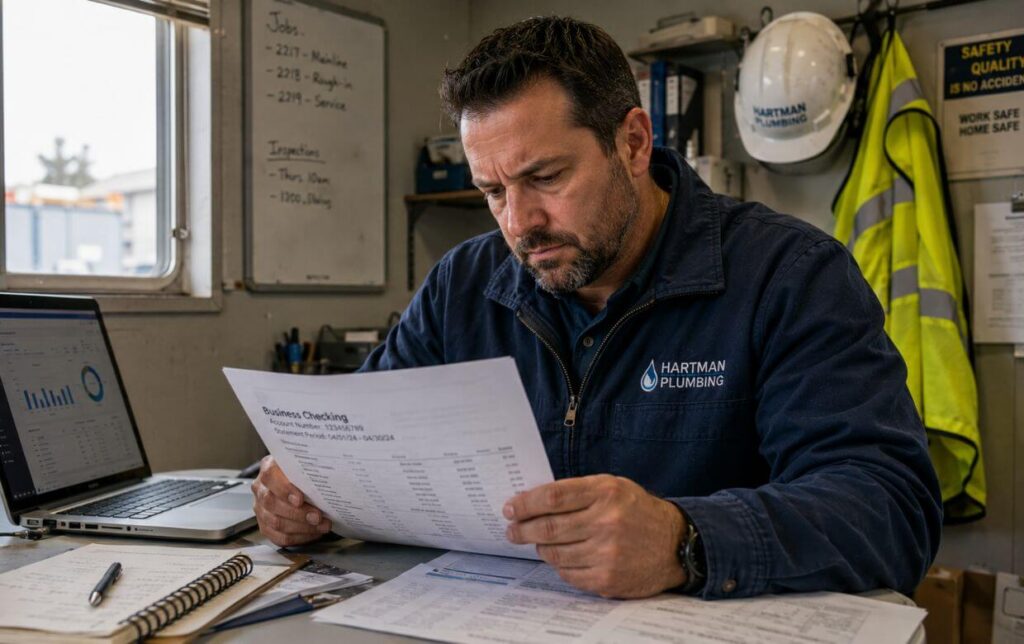
Plumbing contractors who’ve made the move from purely residential work into commercial contracts tend to recognize, often after the fact, that the payment timing shift was the part they underestimated. The work itself wasn’t the hard part; carrying the business through 60 or 90 days of commercial receivables while residential obligations and overhead kept coming due on their normal schedule was. Having financing access lined up before taking on that first larger commercial contract, rather than discovering the gap mid-project, tends to make the difference between a smooth transition and a genuinely stressful one. Understanding how revenue-based financing works for established businesses is a good starting point before a contractor takes on that first major commercial job.
Ready to Bridge the Gap?
Talk to a dedicated account manager about your financing needs
No pressure, no countdown. Your account manager can give you a clear picture of what the business qualifies for before you formally apply.
Apply in 15 Minutes → Explore Lines of Credit InsteadFrequently Asked Questions
What is plumbing contractor financing?
Plumbing contractor financing is revenue-based funding that gives plumbing businesses fast access to working capital for service van upgrades, equipment and parts inventory, and the payment gap that opens up when a business moves from residential service calls into larger commercial contracts. It’s not tied to a single purchase; it’s capital tied to the business’s overall revenue, which makes it usable for whatever combination of needs comes up.
How is this different from an equipment loan for a service van?
An equipment loan is typically tied to a specific purchase, with the vehicle or equipment itself serving as collateral. Plumbing contractor financing through a revenue-based model isn’t tied to one purchase; it’s underwritten against the business’s overall revenue, which makes it a better fit when a contractor has several needs at once, like a van, materials, and payroll, rather than a single isolated purchase.
How much can a plumbing contractor borrow?
Platform Funding offers revenue-based financing from $5,000 to $3,000,000. The specific amount a contractor qualifies for depends on monthly revenue, time in business, and overall financial history, evaluated during the application process.
What are the qualification requirements?
Generally, a plumbing business needs at least 6 months in operation and $10,000 or more in average monthly revenue to qualify. Underwriting also reviews business and personal credit and recent bank statements, though the process moves faster than traditional bank underwriting.
How quickly can a plumbing contractor get funded?
Platform Funding targets a funding decision within 24 to 48 hours of a completed application. Contractors who need to move quickly on a materials order or a payroll gap tied to a commercial project are typically able to go from application to funded within that window.
Why does commercial plumbing work pay so much slower than residential work?
Commercial work typically involves a general contractor, progress billing tied to project milestones, and retainage of 5 to 10 percent of contract value held back until substantial completion. Residential work is usually billed and collected directly from the customer, often the same day or within a couple of weeks, without the layers of approval and milestone billing that slow down commercial payment cycles.
Can this financing cover both residential and commercial needs at the same time?
Yes.
Because the financing is tied to the contractor’s overall business revenue rather than a single project or invoice, it can be applied across whatever combination of residential and commercial needs the business has, including a service van for residential call volume and a materials deposit for a commercial contract within the same funding round.
What happens if a commercial contract’s payment is delayed longer than expected?
Repayment is structured as a percentage of the business’s overall revenue, so it continues to adjust based on what the business is actually generating across both residential and commercial work, rather than assuming any single contract’s payment timeline. This is a meaningful difference from a fixed-payment loan tied to expectations about one project specifically.
Is this only useful for contractors transitioning into commercial work, or can purely residential plumbing businesses use it too?
While this article focuses on the payment timing gap that comes with adding commercial contracts, the same revenue-based financing product is available to plumbing contractors of any mix who meet the qualification requirements, including purely residential businesses managing seasonal demand or an unexpected equipment need.
How does Platform Funding compare to other lenders for plumbing contractors?
Platform Funding offers a 95 percent approval rate among qualifying applicants, funding amounts up to $3,000,000, an A+ Better Business Bureau rating, a 4.9 out of 5 Trustpilot rating from 575 verified reviews, and a dedicated account manager assigned from application through repayment, supported by more than $2 billion funded to over 30,000 businesses. A full list of frequently asked questions about funding requirements and terms is available on the Platform Funding website.