

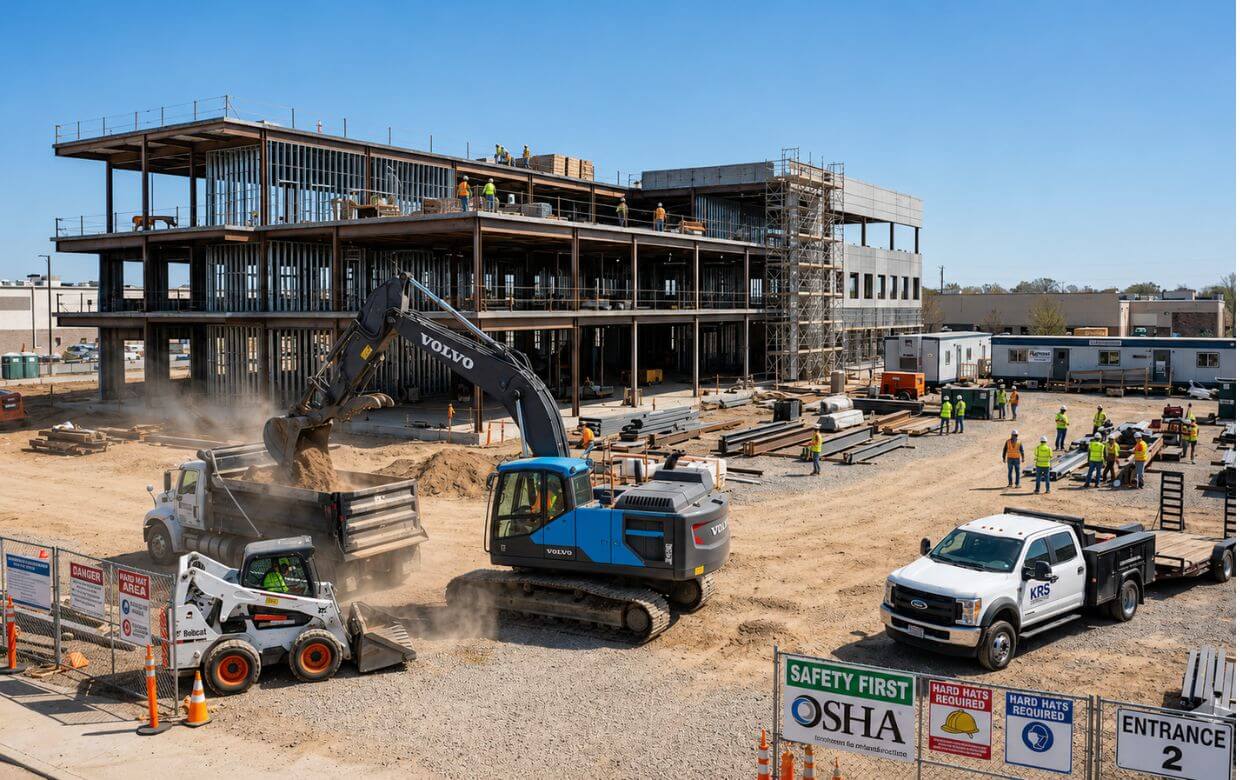
Construction financing provides working capital and equipment funding for established contractors navigating 2026 labor shortages through automation, equipment upgrades, and operational efficiency. Platform Funding offers 24-48 hour financing decisions with revenue-based repayment for construction companies with a 12+ month operating history and $10,000+ monthly revenue, enabling growth investments without depleting project cash flow.
Mid-2026 construction markets present a challenge: project demand remains strong while qualified labor becomes increasingly scarce. Contractors who built teams during 2024-2025 now face retirement waves, competitor poaching, and wage pressures stretching margins.
For established construction companies with a 12+ month operating history, this creates a strategic choice: invest in equipment and efficiency enabling fewer workers to accomplish more, or watch projects go to competitors who’ve already made these investments.
The challenge isn’t recognizing needed changes. It’s financing equipment purchases, technology implementations, and working capital needs without depleting the cash reserves, keeping projects running and payroll covered.
Platform Funding has funded over $2 billion to 30,000+ businesses nationwide, with a 95% approval rate compared to traditional banks’ 27% approval rate. That track record comes from understanding how real businesses operate, not just reviewing credit scores.
Learn what to expect from fast online business loans, including application process, approval timeline, and funding speed.
The 2026 Construction Labor Reality
Construction labor shortages in 2026 reflect demographic shifts years in development: experienced workers retiring faster than new workers entering trades, competing industries offering comparable wages with better conditions, and immigration policies limiting traditional labor pipelines.
The average construction worker age now exceeds 42 years. Retirement projections suggest 20% of the current workforce exits within 5 years. Apprenticeship programs haven’t scaled sufficiently to replace departing expertise.
Meanwhile, project demand continues: infrastructure spending from federal programs, commercial construction recovering, residential building addressing housing shortages, and industrial projects supporting reshoring trends.
The Numbers:
Commercial construction companies report an average 15-20% labor shortage versus optimal crew sizes. Residential builders face 12-18% shortages. Specialty contractors (electrical, HVAC, plumbing) experience 20-25% shortages in skilled positions.
This isn’t a temporary disruption. It’s structural reality requiring operational adaptation, not just hiring harder.
For contractors managing this transition, working capital becomes critical for making strategic investments without waiting months for bank approval while opportunities pass by.
Construction equipment is ready to purchase. Capital is 48 hours away.
Your dedicated account manager understands project-based revenue. They review your full seasonal cycle, not just your slowest month. Apply in 15 minutes and have capital in your account before the week ends.
- No collateral required
- No hidden fees
- Payments flex with project revenue
- Multiple funding rounds available
Strategic Response: Equipment Investment Over Labor Expansion

Forward-thinking contractors recognize 2026 labor constraints require a different strategy than previous decades. Instead of building larger crews, successful contractors invest in equipment and technology enabling smaller crews to accomplish equivalent output.
For detailed guidance on equipment acquisition, review our smart strategies for purchasing equipment.
Equipment Efficiency Gains:
Modern excavators with GPS guidance systems enable a single operator to accomplish work previously requiring two operators plus ground crew. Mini excavators access tight spaces, eliminating hand-digging labor. Telehandlers replace multiple specialty lifts, reducing equipment operator needs.
An Illinois commercial contractor calculated that a $180,000 investment in a GPS-equipped excavator eliminated the need for two additional laborers on site layout and excavation work. Labor cost savings: $140,000 annually. Equipment payback: 15 months.
That’s the math Platform Funding sees repeatedly: equipment investments paying for themselves in 12-18 months through labor savings alone, before counting productivity gains, safety improvements, or competitive advantages.
Technology Multipliers:
Project management software coordinating crews reduces superintendent time per project. Drone surveys eliminating manual site measurements. Prefabrication reduces on-site labor hours. Digital blueprints are accessible on tablets, reducing travel time for plan reviews.
These aren’t luxury upgrades. They’re competitive necessities when you can’t hire enough workers executing projects in traditional ways.
Material Handling Solutions:
Forklifts, telehandlers, material lifts, and crane services reduce manual material moving. Two workers with proper equipment accomplish what previously required six workers’ manual handling.
An Ohio residential builder invested $95,000 in material handling equipment (forklift, telehandler, and scaffold system). Crew productivity increased 30% while reducing injury claims and workers’ compensation costs. Combined savings exceeded $8,000 monthly.
This is construction financing’s strategic purpose in 2026: enabling equipment investments that multiply worker productivity when additional workers aren’t available at sustainable costs.
For contractors ready to make these investments, fast business funding provides capital in 24-48 hours rather than the 6-8 weeks traditional banks require.
Finance any heavy equipment in 24–48 hours
Revenue-Based Financing for Construction Working Capital
Here’s why revenue-based financing works particularly well for construction companies: repayment adjusts to project cash flow patterns rather than fixed schedules conflicting with payment timing.
Construction cash flow differs from retail or service businesses. Projects span weeks or months. Customer payments arrive at milestones or completion. Material costs concentrate at project start. Labor distributes throughout project duration.
Traditional bank loans charging fixed monthly payments regardless of project timing create cash flow mismatches. Revenue-based financing adjusting to actual deposits accommodates construction cash flow reality.
Real Scenario:
A Pennsylvania general contractor secured $120,000 revenue-based financing for equipment and working capital in March 2026. Their cash flow pattern:
- March (funding month): $65,000 revenue deposits, $3,250 repayment (5%)
- April (project starts): $48,000 revenue, $2,400 repayment (5%)
- May (mid-projects): $71,000 revenue, $3,550 repayment (5%)
- June (completions): $94,000 revenue, $4,700 repayment (5%)
- July (new cycle): $52,000 revenue, $2,600 repayment (5%)
Total repayments over five months: $16,500. When June brought multiple project completions and large payments, repayment automatically increased. When April had mostly project starts with deposits but not completion payments, automatic reduction preserved cash flow.
Compare to a traditional loan: $2,800 monthly payment for 48 months. During April, when the contractor had $48,000 revenue but high material costs for project starts, that fixed $2,800 payment creates a cash squeeze. A revenue-based structure protects cash flow during project cycle variations.
This alignment with construction project cash flow makes revenue-based financing particularly suitable for contractors managing multiple simultaneous projects at different stages.
Platform Funding’s 95% approval rate means contractors who’ve been turned down by traditional banks still qualify based on business performance rather than just credit scores.
Types of Construction Financing Needs
Construction companies face diverse capital needs requiring different financing approaches based on use and timeline.
Heavy Equipment Financing
Excavators, bulldozers, loaders, backhoes, and cranes. Core production capability for site work and earthmoving contractors. Cost range: $75,000-$400,000 per machine. Typically financed through equipment-specific loans where equipment serves as collateral.
For broader financing options beyond equipment-specific loans, explore business loans covering multiple capital needs simultaneously.
Light Equipment and Tools
Skid steers, mini excavators, compactors, generators, welders, and specialty tools. Supporting equipment enabling project efficiency. Range: $15,000-$75,000. Often bundled in working capital financing rather than individual equipment loans.
Many contractors use lines of credit for flexible access to working capital covering light equipment and tool purchases as needs arise.
Vehicles and Trailers
Work trucks, service vehicles, equipment trailers, and material delivery trucks. Transportation infrastructure supporting operations. Cost: $30,000-$100,000 per vehicle/trailer. Often financed separately through auto/commercial vehicle loans.
For transportation and logistics contractors, fleet financing becomes critical infrastructure investment rather than an optional upgrade.
Technology and Software
Project management systems, estimating software, GPS equipment, drones, digital tools. Modern construction requires technology infrastructure. Investment: $20,000-$60,000 for comprehensive implementation.
Technology investments are increasingly critical as labor shortages require fewer workers managing more complex projects through digital coordination.
Working Capital for Project Starts
Material deposits, equipment mobilization, and early labor costs before the first customer payment. Essential for contractors taking new projects. Typically $30,000-$150,000 per project depending on size.
Working capital financing bridges the gap between project start costs and the first payment milestone, preventing cash flow constraints limiting project capacity.
For temporary cash flow gaps between projects, explore bridging loans as a short-term solution.
Bonding Capacity Support
Some contractors need cash reserves supporting bonding requirements for commercial and government projects. Accessible capital can increase bonding capacity, enabling larger projects.
Explore how lines of credit specifically benefit construction companies for bonding support and project working capital.
Seasonal Cash Flow Management
Winter months in northern climates, rainy seasons limiting outdoor work, and holiday slowdowns. Seasonal contractors need working capital to maintain operations and crew during slower periods without laying off trained workers.
Restaurant seasonal financing follows similar patterns, though for different reasons (holiday peaks vs. construction weather dependence).
Which financing fits your situation?
- Minimize upfront costs
- Upgrade equipment every few years
- Keep predictable monthly payments
- Rotate smaller tools like skid steers
- Own the equipment outright
- Payments that flex with project revenue
- Capital in 24–48 hours
- Build long-term business equity
Not sure which is right for your business? Your dedicated account manager can walk you through both options before you apply.
Talk to an Account Manager →Qualification Requirements for Construction Financing
Revenue-based financing serves established construction companies with proven project completion capability, not speculative startups or distressed contractors.
For a complete overview of funding requirements across all business types, review our essential guide to business financing success.
12+ Months Operating History Required
Construction businesses under a year old haven’t completed full project cycles, experienced seasonal variations, or proven project management capability. Financing requires confidence the contractor will sustain operations through the repayment period.
Startup contractors need investor capital for initial equipment and operating expenses. This protects both contractor and lender from mismatched expectations.
Learn which industries get approved faster for business loans and how construction compares to other sectors.
$10,000+ Monthly Revenue Minimum
This threshold ensures sufficient cash flow managing financing repayment even during slower project periods. If you’re generating $8,000 one month and $3,000 next without a clear project pipeline, you have business model challenges financing won’t solve.
For construction companies, consistent $10,000+ monthly revenue typically indicates established customer relationships, proven project completion capability, and sustainable operations.
Project Pipeline and Backlog Review
Lenders evaluate not just current revenue but project pipeline. Are you working one project at a time (higher risk) or managing multiple projects with staggered completion (lower risk)? Do you have signed contracts extending 3-6 months?
A Texas concrete contractor with $40,000 monthly revenue but completing all projects in the same month faced initial questions. However, signed contracts totaling $380,000 for the following quarter demonstrated a predictable pipeline justifying approval.
Customer Concentration Assessment
Revenue concentrated with a single general contractor or developer creates risk if that relationship ends. A diversified customer base across multiple projects and clients demonstrates a more stable business model.
A construction company generating 75% of its revenue from a single developer faces more scrutiny than a company with revenue spread across 8-10 different customers even at the same total revenue level.
This diversification principle applies across industries. Healthcare practice financing similarly evaluates patient volume concentration and insurance mix diversity.
Understanding the real cost of delayed receivables helps contractors manage customer payment terms and cash flow timing.
Credit Score Flexibility
Platform Funding doesn’t require perfect credit. Most approved construction companies have credit scores in the 600-720 range. What matters more: business cash flow patterns and project completion history.
A contractor with a 640 credit score but three years of consistent project completions and $50,000+ monthly revenue presents a stronger profile than a 740 credit score attached to an inconsistent project pipeline. Business performance beats personal credit history.
Even if banks say no due to credit challenges, alternative lenders evaluate the complete business picture beyond just credit scores.
That 95% approval rate comes from evaluating the whole business, not just a single credit score number.
Construction contractors and equipment operators with $10,000+ in monthly revenue and at least 12 months of operating history that need $30,000 to $500,000 to purchase or lease excavators, bulldozers, loaders, dump trucks, and heavy machinery without depleting working capital.
| Funding range | $5K – $500K |
| Decision timeline | 24–48 hours |
| Approval rate | 95% |
| Collateral | Not required |
| Repayment | % of daily sales |
| Hidden fees | None |
| Min. monthly revenue | $10,000 |
| Min. time in business | 12 months |
Equipment Investment ROI for Construction Companies
Strategic contractors calculate equipment ROI before financing, ensuring investments generate returns justifying costs.
Labor Replacement Calculation
Equipment replacing or reducing labor needs: Calculate annual labor cost savings versus equipment financing costs. Equipment enabling one worker to accomplish two workers’ output generates clear savings.
A Michigan excavation contractor financed a $160,000 GPS-equipped excavator, replacing two operators plus a survey crew on site layout work. Labor savings: $135,000 annually. Fuel efficiency improvement: $8,000 annually. Total annual savings: $143,000. Financing cost: $4,200 monthly ($50,400 annually). Net savings: $92,600 first year.
These aren’t theoretical projections. These are real numbers from contractors who’ve made these investments and tracked the results.
Productivity Increase Calculation
Equipment enabling the same crew to complete more projects annually: Calculate additional project revenue versus equipment cost.
Georgia framing contractor financed $85,000 in pneumatic nailers, material lifts, and cutting equipment. Crew productivity increased 25%, enabling 3 additional residential frames annually. Additional revenue per frame: $12,000. Additional annual revenue: $36,000. Equipment financing: $2,100 monthly ($25,200 annually). Net gain: $10,800 first year, expanding as financing completes.
Safety and Insurance Reduction
Equipment reducing manual material handling and risky tasks: Calculate workers’ compensation insurance reductions and injury claim avoidance.
A Florida roofing contractor invested $70,000 in material lifts and fall protection equipment. Workers’ compensation insurance premium reduced 18% ($9,400 annually). Injury claims dropped from 3 annually to zero. Combined savings exceeded financing costs within the first year.
Bid Competitiveness Improvement
Equipment enabling lower bid pricing or faster project completion: Calculate additional project wins versus previous win rate.
A commercial contractor acquiring $200,000 in specialized concrete equipment enabled them to bid on tilt-up projects previously requiring subcontractor outsourcing. Additional project wins: 4 annually, averaging a $75,000 margin each. Additional annual profit: $300,000. Equipment financing: $5,500 monthly. ROI: Exceptional.
Equipment investments during labor shortages generate returns through multiple channels simultaneously: labor savings, productivity gains, safety improvements, and competitive positioning.
Understanding the true cost of equipment downtime helps contractors justify financing decisions before breakdowns create project delays.
For contractors in specialized verticals like automotive repair or dental equipment, similar ROI calculations apply with industry-specific equipment considerations.
Managing Construction Cash Flow During Growth
Growing construction companies face a challenge: success creates cash flow pressure. More projects require more working capital for materials, equipment, and labor before customer payments arrive.
The Growth Cash Flow Trap:
Month 1: Complete $200,000 project, receive payment, strong cash position
Month 2: Start three new $180,000 projects requiring $90,000 material deposits, $35,000 equipment costs, and $45,000 early labor. Total outflow: $170,000 before any completion payments.
Month 3: The first project is halfway done, and the second and third are just starting. Revenue arriving from milestone payments covers some costs but not full outflow.
Month 4: The first project is complete, bringing payment, but two additional projects requiring new deposits have started.
This cycle isn’t mismanagement. It’s a construction business model where project start costs precede completion revenue. As contractors grow and project counts increase, cash flow demands intensify.
Learn how to prevent cash flow nightmares during explosive business growth before rapid expansion creates financial pressure.
Strategic Working Capital Management:
Successful contractors maintain a working capital cushion separate from project-specific cash flow. This cushion covers material deposits for new projects, equipment repairs between projects, payroll during project gaps, bid bonds, and performance bonds.
Revenue-based financing provides this cushion without requiring asset collateralization or personal guarantees typical of traditional construction lending.
Arizona contractor maintains a $150,000 working capital cushion through revenue-based financing, enabling them to accept new projects while existing projects are mid-cycle without depleting operating reserves. Repayment adjusts to project completion timing rather than a fixed schedule.
This approach works across service industries. Professional services firms and marketing agencies face similar cash flow timing challenges between project starts and client payments.
Construction financing strategies also apply to trucking businesses, retail stores, pharmacies, and beauty salons managing equipment purchases and seasonal cash flow.
Seasonal Construction Financing Strategies
Construction seasonality varies by region and specialty, requiring tailored financing approaches.
For comprehensive strategies on managing cash flow across seasonal cycles, read our guide on seasonal business financing.
Northern Climate Contractors (Peak April-October):
Winter months bring reduced outdoor work but continued overhead: equipment storage, maintenance, payroll for key employees, insurance, and facility costs. Working capital financing bridges the winter gap without laying off trained crews.
Minnesota commercial contractor uses revenue-based financing, maintaining a core 8-person crew through winter when outdoor work stops. An alternative would be layoffs requiring rehiring and retraining each spring. Financing cost of maintaining crew: $35,000 for the winter season. Value of a retained skilled crew versus spring hiring challenges: Immeasurable in the 2026 labor market.
Southern Climate Contractors (Year-Round with Summer/Hurricane Disruptions):
Summer heat limiting outdoor hours or hurricane season disrupting schedules creates temporary revenue dips requiring working capital continuity.
A Louisiana contractor experienced a 5-week hurricane disruption in August 2026. Revenue-based financing repayment was automatically reduced during disruption, then increased when projects resumed in September. Fixed-payment financing would have created a cash crisis during the disruption.
Weather-Dependent Specialties:
Roofing, concrete, excavation, and paving are highly weather-dependent. Revenue fluctuates with weather patterns, requiring flexible financing that accommodates the reality that you can’t pour concrete in freezing weather or install roofing in high winds.
Project-Type Seasonality:
Residential contractors experience spring-summer peak. Commercial contractors experience year-round demand with budget cycles affecting starts. Government contractors face fiscal year timing affecting project releases.
Understanding your specific seasonal pattern enables strategic financing timing: secure capital before peak season starts rather than during peak season when you’re already stretched.
Retail businesses experience similar seasonal pressures, though tied to holiday shopping cycles rather than weather patterns.
Similarly, restaurant funding options address seasonal demand fluctuations, equipment needs, and working capital for food service businesses.
Technology Investment for Labor-Short Construction Companies
Modern construction technology multiplies worker productivity, a critical advantage during labor shortages.
Project Management Platforms:
Cost: $200-$800 monthly subscription per company. ROI: Reduced superintendent time per project (15-25% time savings), fewer errors and rework (5-10% cost reduction), improved schedule adherence (fewer delays).
A contractor managing 6-8 simultaneous projects can justify a project management platform through superintendent time savings alone. A platform enabling a superintendent to manage 8 projects versus 6 projects creates effective labor multiplication.
Drone Survey and Mapping:
Cost: $2,000-$5,000 for equipment plus $100-$300 monthly for software. ROI: Site surveys completed 5-10x faster than manual methods, accurate volume calculations for excavation and material quantities, and progress documentation for customers and stakeholders.
A site survey taking a surveyor 8 hours can be completed with a drone in 45 minutes. For contractors doing frequent surveys, ROI reaches months, not years.
GPS Equipment Guidance:
Cost: $15,000-$40,000 per machine. ROI: A single operator replacing a two-person crew, improved accuracy reducing rework, faster project completion, and fuel savings from optimized paths.
Excavation contractors report GPS guidance reducing site work time 20-30% while improving accuracy. For contractors running equipment full-time, payback under 18 months is typical.
Prefabrication and Modular Systems:
Cost: Varies by system and project type. ROI: Reduced on-site labor hours (30-50% reduction), improved quality control, faster project completion, weather-independent work.
Commercial contractors are increasingly using prefabricated mechanical systems, wall panels, and structural components manufactured off-site. On-site assembly requires fewer skilled workers and completes faster than traditional construction.
Digital Takeoff and Estimating:
Cost: $1,500-$5,000 for software. ROI: Faster bid preparation (50% time reduction), improved accuracy (fewer estimation errors), and the ability to bid on more projects with the same estimating capacity.
Technology investments create leverage: the same number of people accomplish more work through digital tools than traditional manual methods.
IT services companies helping contractors implement these systems also benefit from revenue-based financing for their own growth capital needs.

The Platform Funding Approach to Construction Financing
Platform Funding structures construction financing specifically for established contractors needing speed, flexibility, and repayment aligned with project cash flow cycles.
Discover alternative business funding options beyond traditional bank loans for small business growth.
Speed Enables Opportunity Capture:
Construction opportunities often require quick decisions: equipment auctions, material purchase discounts, and project bids requiring immediate bonding. Waiting 6-8 weeks for bank approval means missing opportunities.
Application to funding: 24-48 hours for established construction companies meeting qualification criteria. Submit financial documentation (bank statements, project pipeline schedule) and receive a preliminary decision the same day and final approval and funding within 48-72 hours.
That speed comes from Platform Funding’s streamlined underwriting focused on business performance, not just credit committee approval chains. See how it works and read contractor testimonials from businesses funded nationwide.
Project Cycle Alignment:
Construction revenue fluctuates with project starts, milestone payments, and completions. Revenue-based repayment adjusts automatically: project completion months mean higher repayment (but you can afford it from completion payments), and project start months mean automatic reduction (when you’re deploying capital but haven’t received completion payments).
This structure particularly benefits contractors managing multiple projects at different stages where revenue timing varies monthly based on which projects reach completion.
Equipment and Working Capital Combination:
Construction companies commonly need both equipment financing and working capital simultaneously. A single financing package covering both needs simplifies capital structure versus multiple separate financings with different lenders.
Contractor financing of $180,000: $120,000 for excavator purchase and $60,000 working capital for project materials and cash flow. Single application, single repayment structure, single relationship.
Multiple Rounds for Growing Contractors:
Successful first financing creates a track record enabling future financing with minimal documentation. Many construction companies use Platform Funding multiple times: initial equipment purchase, working capital injection 6 months later, and additional equipment the following year as business grows.
Each successful repayment builds relationships and simplifies future capital access as a contractor’s business scales.
Over $2 billion funded to 30,000+ businesses proves this model works across industries and business types, from manufacturing operations to beauty salons to construction contractors.
Frequently Asked Questions About Construction Financing
Can new construction companies get financing before completing their first year?
No. Financing serves established construction companies with a 12+ month operating history and $10,000+ monthly revenue. Startup contractors need investor capital for initial equipment and operations. Lending to unproven construction companies creates risk neither party benefits from. The 12-month requirement protects contractors from taking debt before they’ve proven project completion capability and cash flow sustainability.
Do I need signed contracts to qualify for equipment or working capital financing?
Signed contracts strengthen applications by demonstrating a project pipeline but aren’t strictly required. Contractors with consistent project history and revenue patterns qualify based on demonstrated capability even without specific contracts in hand at application time. Platform Funding’s 95% approval rate reflects flexibility in evaluating the whole business picture rather than single data point requirements.
Before accepting any financing offer, review our guide on understanding your loan terms before you sign to ensure you know the total cost and repayment structure.
Can I finance both new and used construction equipment?
Yes. Both new and used equipment typically qualify for financing. Used equipment considerations: age (typically under 10-15 years), condition, maintenance records, fair market value. Used equipment may require slightly larger down payments than new. The key evaluation: Does the equipment generate revenue justifying financing cost?
What about financing specialty construction equipment?
Specialty equipment (concrete pumps, tower cranes, specialized paving equipment, etc.) qualifies for financing if it’s integral to your construction operations. Lenders evaluate equipment value and revenue generation capability rather than just equipment type. Platform Funding has financed everything from standard excavators to highly specialized industrial equipment.
How do payments work during winter or the slow season?
Revenue-based financing adjusts to actual revenue. A winter month generating $18,000 revenue means a proportionally lower repayment than a summer month generating $75,000. The percentage stays constant; dollar amount fluctuates with business performance. No modification requests needed, no defaulting from seasonal slowdowns. This automatic adjustment protects construction contractors from fixed payment cash flow mismatches during predictable slow periods.
Can residential and commercial contractors both qualify?
Yes. Both residential and commercial contractors qualify if meeting basic criteria: 12+ months operating, $10,000+ monthly revenue, demonstrated project completion capability. Evaluation considers project type and payment cycles but doesn’t exclude either residential or commercial work. Platform Funding serves contractors across all construction verticals from single-family residential to large commercial projects.
What if I’m transitioning from subcontractor work to general contracting?
Established subcontractors transitioning to general contractor roles typically qualify if maintaining revenue levels during transition. Key evaluation: project management capability and customer pipeline supporting general contractor work versus pure subcontractor work. The transition itself isn’t disqualifying as long as revenue and project completion track records remain consistent.
Do I need bonding capacity to qualify for financing?
Bonding not required for financing qualification. Many smaller contractors work on projects not requiring bonds. Bonding capacity can strengthen applications by demonstrating additional project capability but isn’t a prerequisite for approval. Platform Funding serves contractors across all project sizes and types.
Can I get financing for multiple equipment items simultaneously?
Yes, up to $500,000 total financing. Construction companies commonly finance comprehensive equipment packages: excavator, skid steer, trailer, and tools in single financing rather than separate applications for each item. A single application covering all needs simplifies the process and creates a unified repayment structure.
What credit score is required for construction financing?
Platform Funding typically approves construction companies with 600+ credit scores if the business demonstrates consistent cash flow and project completion history. Business performance and operating track record matter more than personal credit scores. A 640 score with three years of consistent $60,000+ monthly project completions presents a stronger profile than a 720 score with six months of inconsistent revenue. That 95% approval rate reflects looking beyond credit scores to full business performance.
Taking Action on Growth Capital
Mid-2026 labor shortages require a strategic response: invest in equipment and efficiency to multiply worker productivity or struggle to compete with contractors who’ve already made these investments.
Construction companies waiting for labor markets to normalize will wait years. Demographic trends driving 2026 shortages continue through the decade. Adaptation isn’t optional.
Your action items:
Week 1: Productivity Assessment
- Calculate current crew productivity per project
- Identify bottlenecks where equipment could replace labor
- Review equipment currently rented that could be owned
- Calculate labor cost savings from equipment investments
Week 2: Equipment Research
- Research equipment addressing identified bottlenecks
- Compare new versus used equipment options for each need
- Get quotes from multiple equipment dealers
- Calculate ROI for each equipment investment
Week 3: Financial Planning
- Determine total investment range ($50K-$300K)
- Evaluate equipment financing versus working capital needs
- Review current project pipeline and backlog
- Model cash flow with equipment acquisition and financing
Week 4: Financing and Implementation
- Compare equipment loans versus revenue-based financing
- Apply for financing before equipment purchase commitments
- Coordinate equipment delivery with project schedules
- Plan crew training on new equipment
Review our business loan application checklist to ensure you have all required documentation ready before applying.
Platform Funding has financed construction equipment and working capital for general contractors, specialty contractors, excavation companies, and residential builders nationwide. $5,000 to $500,000 financing range. 24-48 hour decisions. Revenue-based repayment adjusting to project cash flow cycles.
If your construction company has a 12+ month operating history and generates $10,000+ monthly revenue, you likely qualify for financing enabling equipment investments and working capital access without depleting project reserves.
Over $2 billion funded to 30,000+ businesses. 95% approval rate. A+ BBB rating. Real contractors, real results, real capital when you need it.
Apply now or call (866) 473-1455 to speak with a construction financing specialist.
Platform Funding serves established construction companies nationwide with equipment financing, revenue-based financing, and working capital solutions. $2B+ funded to 30,000+ businesses. 95% approval rate. Specialized construction industry expertise for contractors navigating labor market challenges.